



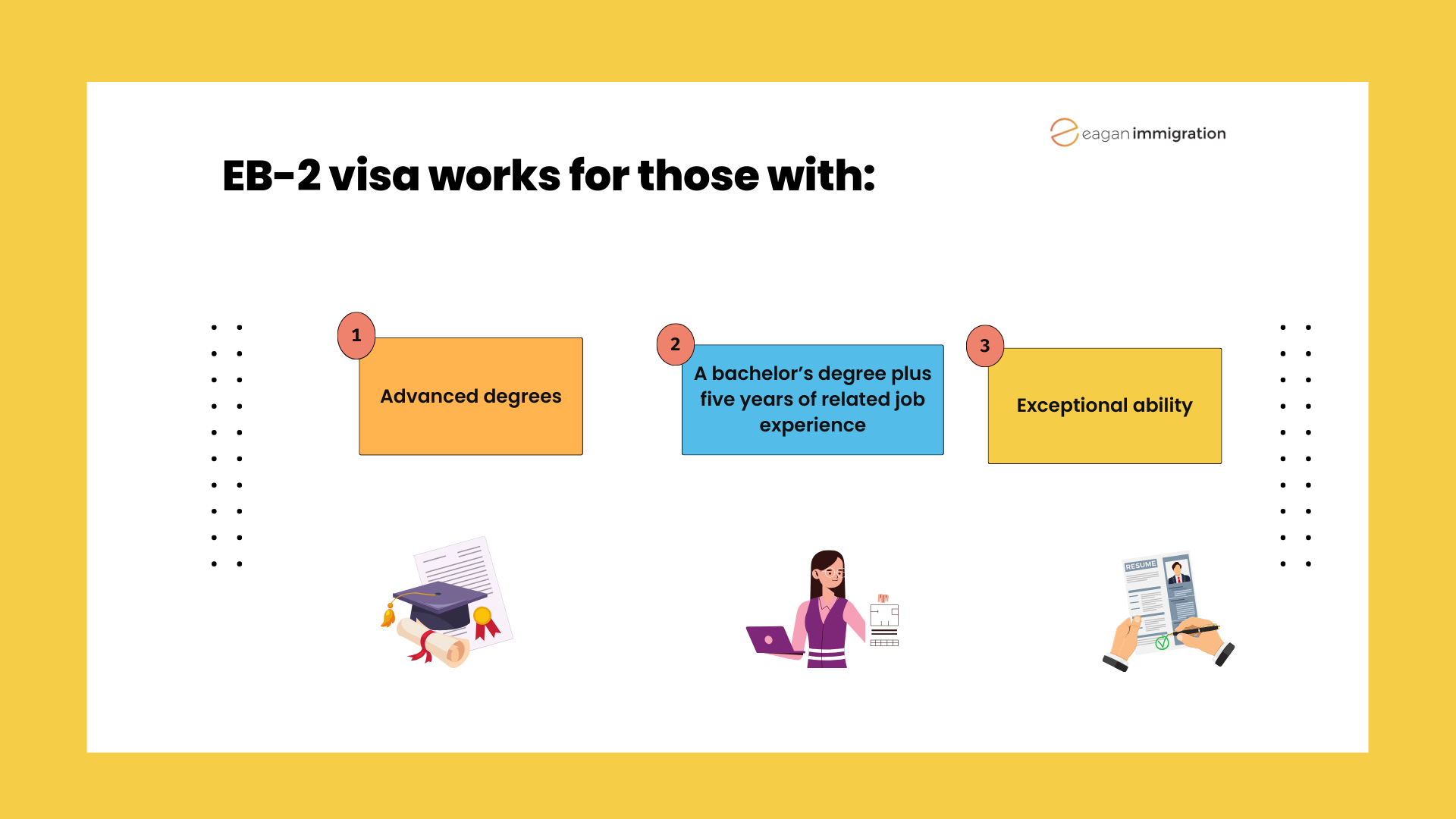
- An official academic record that shows the beneficiary has a degree, diploma, certificate, or similar award from an educational institution
- Letters from current or former employers documenting at least 10 years of full-time employment
- Licensing or certification to practice a profession
- Proof that the beneficiary has commanded a higher salary than others in their field
- Membership in a professional association
- Recognition of achievements and/or contributions by peers, government entities, and professional or business organizations
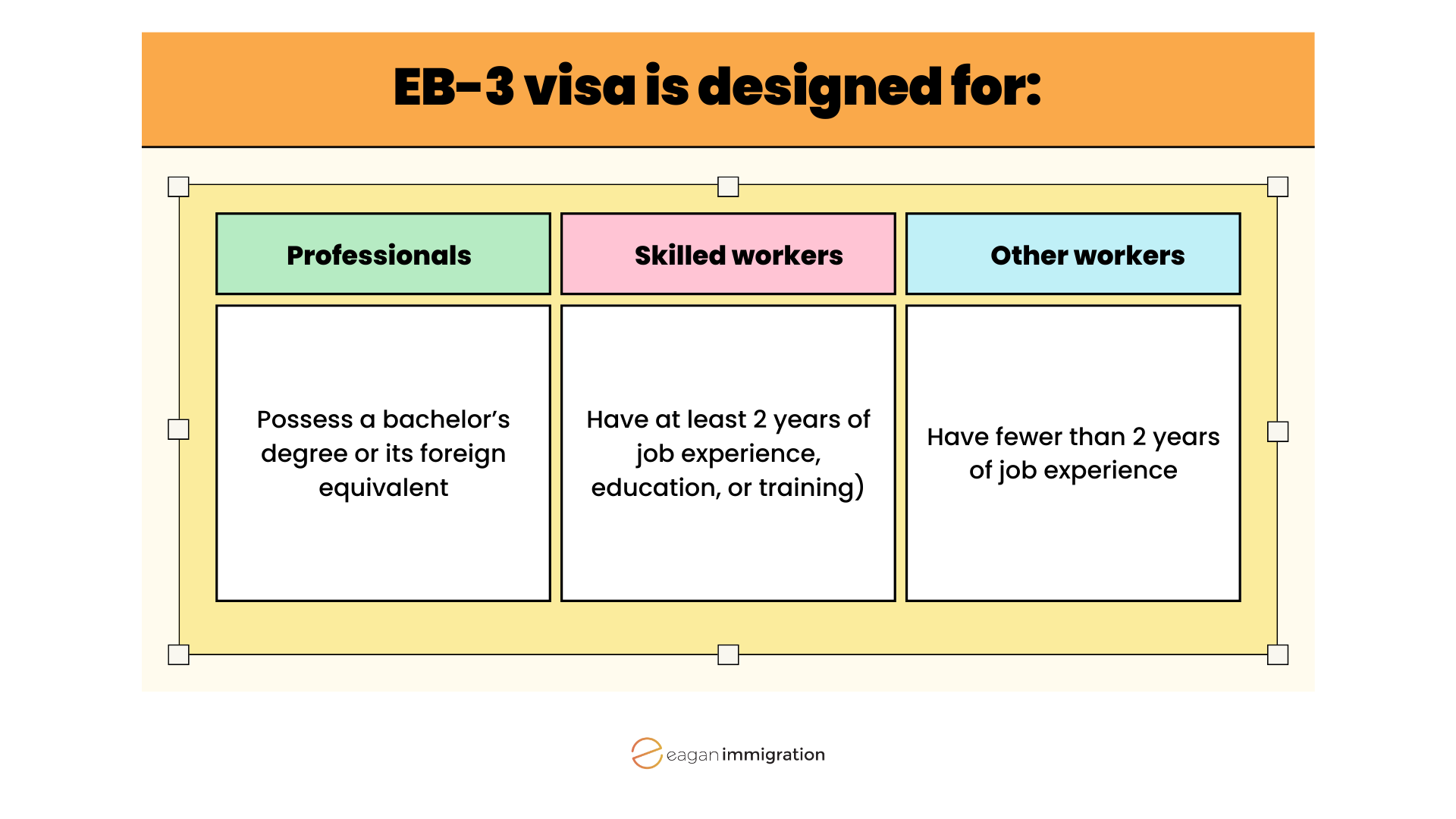
- Skilled workers have at least two years of job experience, education, or training.
- Professionals have a bachelor’s degree or its foreign equivalent.
- Other workers, also known as “unskilled workers,” can have fewer than two years of job experience but must be able to demonstrate the ability to perform unskilled labor.
 Because the EB-3 pathway accommodates a wide range of workers, many view this as a good option for sponsoring family members if their business has an open position that does not require experience or a degree.
The PERM Process
Both the EB-2 and EB-3 employment pathways require the employer to file a PERM Labor Certification. The PERM is essentially designed to let employers hire foreign workers while also ensuring there are no capable U.S. workers able, willing, qualified, or available to fill the open position. These standards are designed to ensure that employers do not purposefully choose foreign workers over U.S. workers. This process is also very important to the Department of Labor (DOL) and USCIS when examining those who hire foreign relatives. Filing the PERM is a multi-step process:- Identify the open position at your business. This must be a permanent, full-time position, and having the job title, responsibilities, and skills required for this position will be important throughout the PERM process. This position should not be specifically tailored to your relative’s skills because it could cause the DOL to believe that you created this position for your family member. The DOL wants to see that you have hired people for similar positions in the past to ensure that it is a true job offer.
- Determine the prevailing wage. The prevailing wage is essentially the average wage for U.S. workers in specific locations and jobs. If you hire a foreign worker, the prevailing wage ensures he or she is paid appropriately so it doesn’t negatively affect U.S. workers’ wages. To determine the prevailing wage, you’ll submit Form ETA-9141 (Application for Prevailing Wage Determination) to the National Prevailing Wage Center. This form will require you to provide information about the job title, responsibilities, and required education and experience. Soon after, you’ll receive the prevailing wage determination.
- Recruit workers. Once you have the prevailing wage, the next step in this process is recruiting workers to interview for the position. You must advertise the open position for about a month, but the type of advertisement required differs depending on what job is being offered. Our post on how to file a PERM breaks down the recruitment process further. During recruitment, it’s important that you genuinely interview candidates. You’ll have to provide documentation as to why certain candidates weren’t the right fit for the open position, so it’s important to be honest during this process. If you interview a candidate who is a better match for the job than your family member but still choose to hire your relative, the DOL will likely see this as a cause for denial.
- File the PERM labor certification. If you’ve determined that the best candidate for the job is your relative, it’s time to file the ETA Form 9089 (Application for Permanent Employment Certification) with the DOL. This form will require you to provide information about the job opportunity, the prevailing wage, and the foreign national candidate you’ve chosen to hire. During this process, you must notify the DOL that you have chosen to hire a relative. Justia explains that the DOL’s definition of family is “[broader] than you might expect and covers any relationship based on blood, marriage, or adoption. Thus, a cousin of any degree is considered a family member, as is any stepchild, stepparent, or in-law.” If you don’t identify the beneficiary as a family member, the DOL will deny the application.
Processing Times and Next Steps As of May 2024, it’s taking the DOL between 397 and 477 days to process PERM applications. Although this may seem like a long time, it’s years shorter than family-based petitions. In fact, as of May 2024, it’s taking the National Service Centers as long as nine years to process some petitions for family members of U.S. citizens or LPRs.See this Instagram post
 After the PERM is approved, you will file the Form I-140 (Immigrant Petition for Alien Workers) with USCIS. As of May 2024, it’s taking the Nebraska Service Center 7 months to process the I-140 for EB-2 applications and 8.5 months for the Texas Service Center. As for EB-3 Form I-140 petitions, it’s taking between 7.5 and 9 months them to be processed at the Nebraska and Texas Service Centers.
Once the Form I-140 is approved, your relative can adjust his or her status. This process will differ depending on if they’re in the U.S. or if they’re living outside of the country. If they’re in the U.S., they will submit the Form I-485 (Application to Register Permanent Residence or Adjust Status), attend a biometrics appointment, and then receive their green card. If they’re outside of the U.S., they’ll file the DS-260 (Electronic Application for an Immigrant Visa), attend a biometrics appointment, attend a visa interview, and then receive their green card.
After the PERM is approved, you will file the Form I-140 (Immigrant Petition for Alien Workers) with USCIS. As of May 2024, it’s taking the Nebraska Service Center 7 months to process the I-140 for EB-2 applications and 8.5 months for the Texas Service Center. As for EB-3 Form I-140 petitions, it’s taking between 7.5 and 9 months them to be processed at the Nebraska and Texas Service Centers.
Once the Form I-140 is approved, your relative can adjust his or her status. This process will differ depending on if they’re in the U.S. or if they’re living outside of the country. If they’re in the U.S., they will submit the Form I-485 (Application to Register Permanent Residence or Adjust Status), attend a biometrics appointment, and then receive their green card. If they’re outside of the U.S., they’ll file the DS-260 (Electronic Application for an Immigrant Visa), attend a biometrics appointment, attend a visa interview, and then receive their green card.
The H-2A and H-2B Visas
You can also sponsor relatives through the H-2A and H-2B visas. These visas differ from the EB-2 and EB-3 employment-based green cards in that they do not provide a pathway to obtaining a green card. Instead, they allow the beneficiary to work temporarily in the United States. Because of this, they do not require a PERM labor certification but instead require a temporary labor certification, which we’ll discuss later. The H-2A is a temporary or seasonal agricultural visa for farm and ranch workers, landscapers, agricultural machinery operators, and others. The H-2B is a temporary visa for nonagricultural positions, including jobs in the hospitality industry, maintenance positions, amusement park jobs, and others. Like the H-2A, the H-2B is a temporary visa. However, the job must fall under one of the following categories: seasonal need, intermittent need, peak-load need, or a one-time occurrence. We discuss each of these types of temporary employment in our H-2B Visa Blog Post.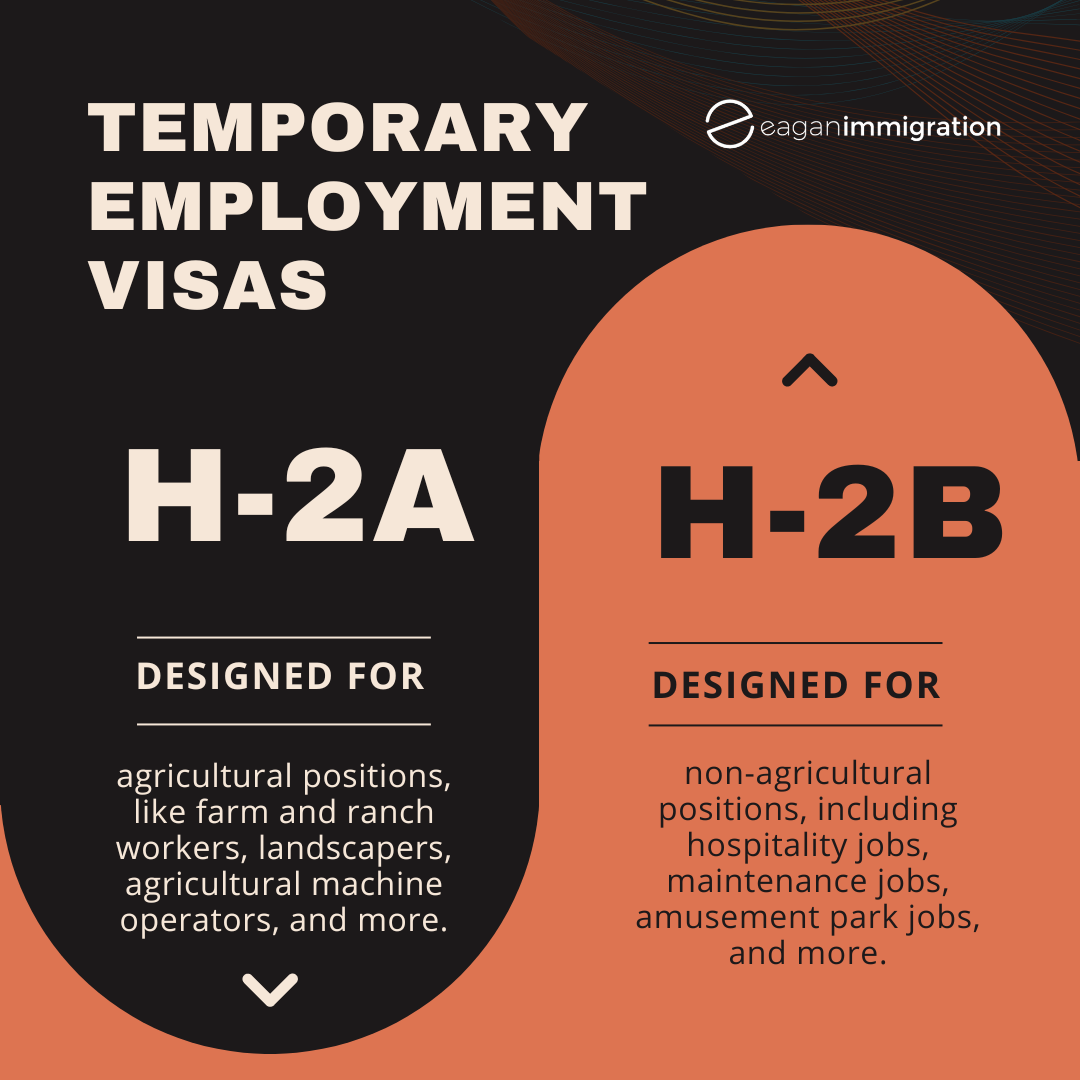
Temporary Labor Certification
The temporary labor certification is similar to the PERM labor certification in that it requires the employer to determine the prevailing wage and conduct recruitment. As we mentioned earlier, it’s important that you prove to the DOL and USCIS that the open position isn’t tailored to your relative’s skills and that you genuinely attempted to recruit U.S. workers. Now, let’s break down the full steps:- Obtain the prevailing wage determination. As with the PERM, you’ll submit information about the open job position to the National Prevailing Wage Center so you can determine the minimum wage to pay a foreign worker.
- Prepare a job order, statement of temporary need, and Form ETA-9142B (Application for Temporary Employment Certification). You’ll prepare these documents after you obtain the prevailing wage determine. The job order is a document highlighting the open position and its duties and required experience. The statement of temporary need is a document that requires you to identify how long you need someone to work at your business. Form ETA-9142B is the application for temporary employment and includes all the information about the open position, how long the applicant will be needed, and the prevailing wage determination.
- Send the prevailing wage determination, Form ETA-9142B, job order, and statement of temporary need to the DOL.
- Receive notification of acceptance and participate in the recruitment process. Once the DOL approves the aforementioned documents, it’s time to begin recruitment. Just as with the PERM process, you must prove that no willing, capable, qualified, or available U.S. workers are available to fill the open position.
- Submit the recruitment report, wait for the temporary labor certification, and submit Form I-129 (Petition for a Nonimmigrant Worker) to USCIS.
What’s Next?
After you have completed the temporary labor certification process, if the relative you have chosen to hire is living in the U.S., you can request that his or her status be changed to H-2B visa worker when filing Form I-129. If your relative is living outside the U.S. when you submit Form I-129, he or she can apply for an H-2A or H-2B visa with the U.S. Department of State. at his or her country’s U.S. Embassy or Consulate. Then they will have to attend a visa interview. Once he or she receives the H-2A or H-2B visa, he or she will be able to seek admission through U.S. Customs and Border Protection at a port of entry. As of May 2024, it is taking the California Service Center just 15 days to process Form I-129 for H-2A visas. For Form I-129 for H-2B visas, the California Service Center is processing the form in one month, while the Vermont Service Center is processing them in two months, according to USCIS.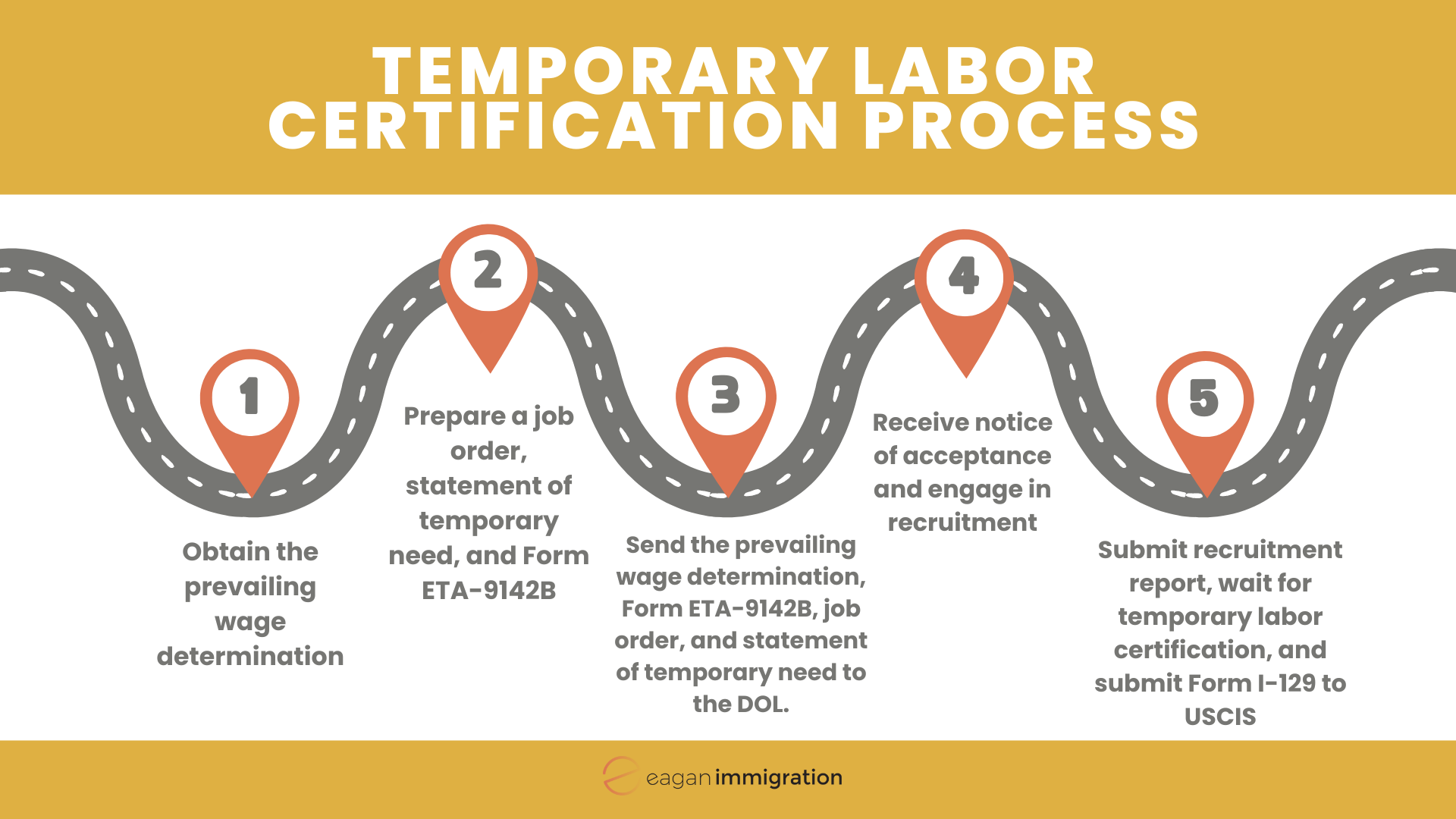 Although it is perfectly legal for you to ask a family member to work for your business, iIt is important to note that the DOL and USCIS will closely examine employment-based sponsorships for family members. These organizations are aware that some petitioners might try to skirt around the criteria for certain employment-based green cards or visas to reduce processing times and get their relatives to the U.S. faster. Because of this, it’s imperative that if you’re interested in pursuing this path, you must be willing to fully comply with DOL and USCIS standards, provide a true job offer, put in a good-faith effort in the recruitment process, and be honest that you are hiring a family member if you do so.
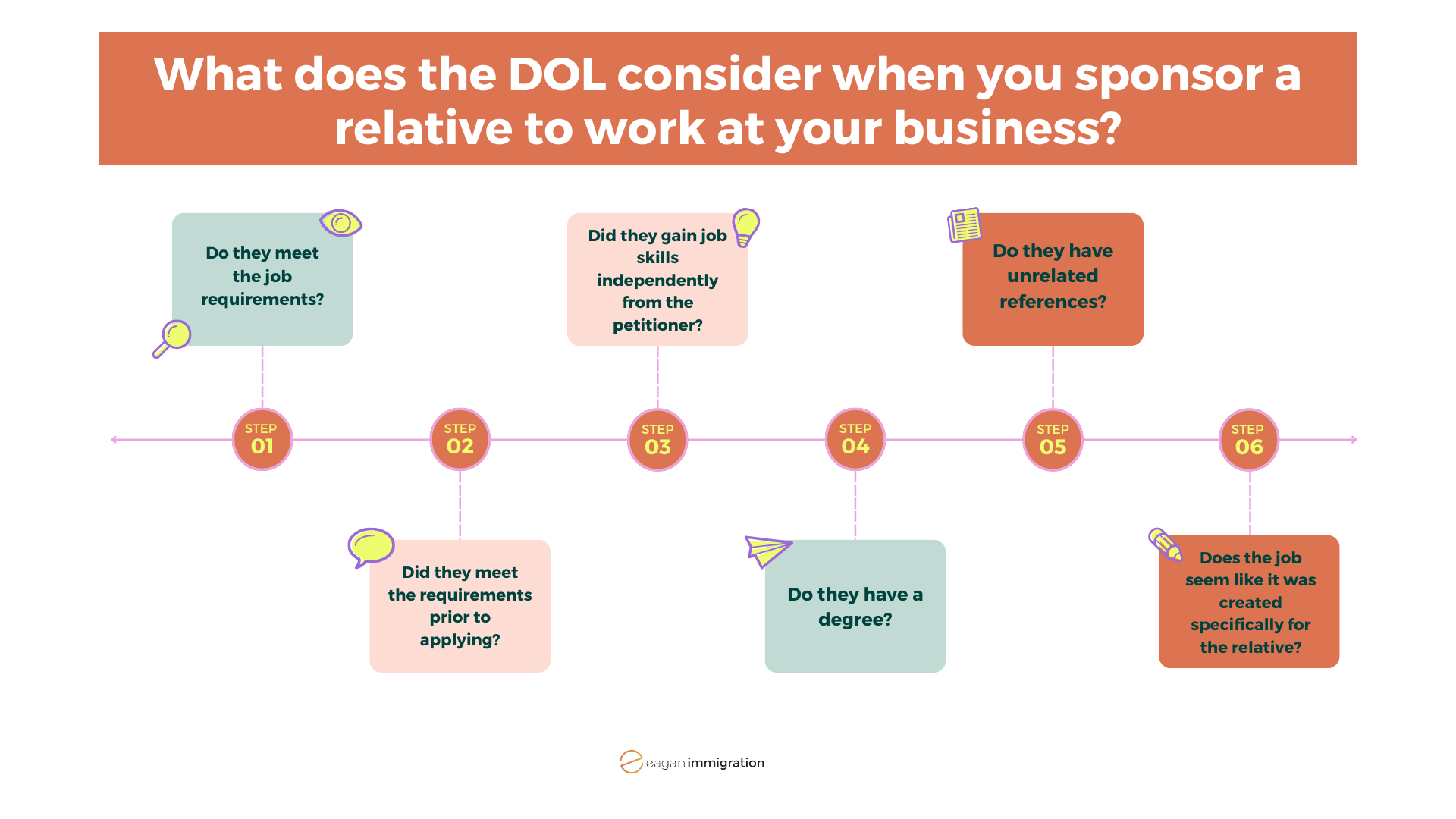
The main takeaway here is that the DOL is seeking legitimacy in this process. They want proof that your relative did not influence hiring decisions and that you did not create a position specifically for them. In addition, they’ll want to know if your hired relative owns part or all of the company.
To minimize the DOL’s concerns, you should not only prove that the hired relative meets the requirements, but they also met the requirements prior to applying for the job and did not gain experience through you. Other good indicators are having a degree and unrelated references.
The process of hiring your family members to work for your business can seem daunting and overwhelming. That’s why Eagan’s senior business attorney, Attorney Hannah Whaley, is here to help. Attorney Whaley can help streamline the process by guiding you through each step and ensuring that you answer all the questions the DOL and USCIS might have. Furthermore, she’ll keep you updated on your case and provide helpful insights every step of the way.
If you're interested in hiring your family members for your business, you can contact us today by calling our office at (202) 709-6439or clicking this link.
Although it is perfectly legal for you to ask a family member to work for your business, iIt is important to note that the DOL and USCIS will closely examine employment-based sponsorships for family members. These organizations are aware that some petitioners might try to skirt around the criteria for certain employment-based green cards or visas to reduce processing times and get their relatives to the U.S. faster. Because of this, it’s imperative that if you’re interested in pursuing this path, you must be willing to fully comply with DOL and USCIS standards, provide a true job offer, put in a good-faith effort in the recruitment process, and be honest that you are hiring a family member if you do so.
The main takeaway here is that the DOL is seeking legitimacy in this process. They want proof that your relative did not influence hiring decisions and that you did not create a position specifically for them. In addition, they’ll want to know if your hired relative owns part or all of the company.
To minimize the DOL’s concerns, you should not only prove that the hired relative meets the requirements, but they also met the requirements prior to applying for the job and did not gain experience through you. Other good indicators are having a degree and unrelated references.
The process of hiring your family members to work for your business can seem daunting and overwhelming. That’s why Eagan’s senior business attorney, Attorney Hannah Whaley, is here to help. Attorney Whaley can help streamline the process by guiding you through each step and ensuring that you answer all the questions the DOL and USCIS might have. Furthermore, she’ll keep you updated on your case and provide helpful insights every step of the way.
If you're interested in hiring your family members for your business, you can contact us today by calling our office at (202) 709-6439or clicking this link.