



By Natalie McQuilkin
Are you a foreign national with extraordinary ability in the sciences, arts, education, business, or athletics? Have you received national or international awards or recognition for your success in your field? Are you interested in obtaining lawful permanent residence in the United States?
If so, you could be a candidate for the EB-1A green card!
What is the EB-1A green card?
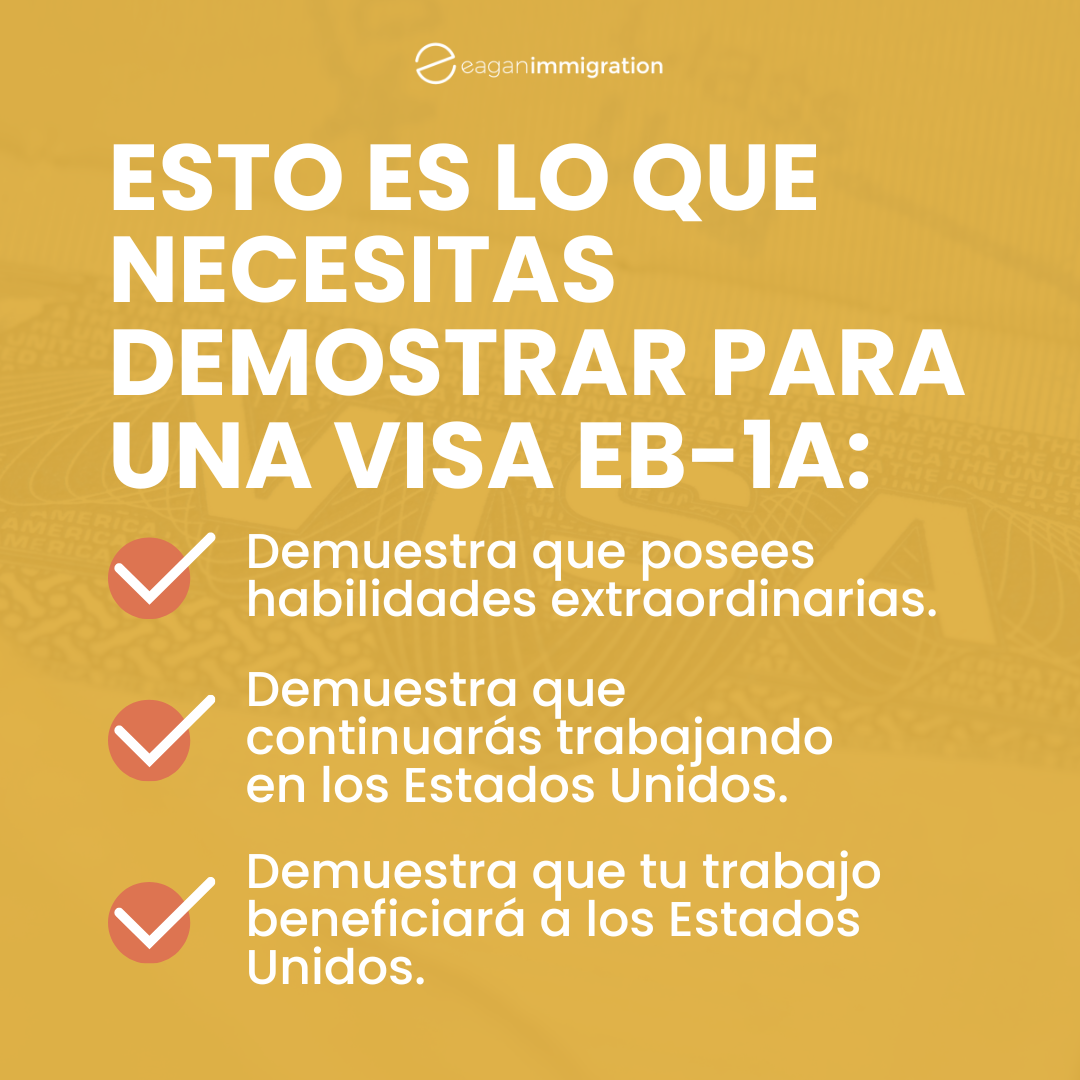
Designed to accommodate those with extraordinary ability in the arts, sciences, education, business, or athletics, the EB-1A visa requires you to provide evidence of the following:
1. Meets the criteria of the United States Citizenship and Immigration Services (USCIS) for extraordinary ability
He plans to continue his work in his field once he comes to the United States
3. Your presence and work in the US will substantially benefit the country
This is a self-petition green card, which means you do not need an employer to sponsor you: you can apply for the green card on your own by providing the necessary evidence required by USCIS.
Before diving into the EB-1A application process, let's break down what each of these requirements means.
Evidence of Extraordinary Ability
To meet the requirements for the EB-1A green card, USCIS requires you to provide evidence that you have extraordinary ability in your field. You can do this in two ways:
1. Provide evidence of having been recognized nationally or internationally through a prize or award and having received national or international acclaim, or
2. Meet three of the 10 USCIS criteria, listed below.
National and international recognition
To demonstrate that you have national or international recognition, you can present evidence that you have received a major award, such as the Nobel Peace Prize, a Pulitzer Prize, an Oscar, or an Olympic medal. Other examples include industry-specific awards, such as a National Book Award, the National Medal of Science, a Grammy, or an Emmy.
Along with providing evidence that you have a national or international award, you are demonstrating that you have “sustained” your acclaim over time. For USCIS, this explains that you still have a significant level of recognition in your field when applying for the EB-1A. Therefore, if you have not been active in a field where you were once prestigious, you would not have maintained your level of acclaim and would not be eligible for the EB-1A.
Compliance with other criteria
If you do not have a national or international award or have not maintained your recognition in your field, do not worry. You may be eligible for the EB-1A green card if you meet three of the following 10 criteria that USCIS requires for extraordinary ability:
· Evidence of having received nationally or internationally recognized awards or prizes for excellence. These may include awards from national institutions or doctoral dissertation awards.
· Evidence of being part of an association in your field that requires members to have outstanding achievements
· Evidence of material published about you in major professional or trade publications or other major media. Examples include newspaper articles, textbooks, major online publications, or transcripts of professional or major audio or video coverage.
· Evidence that you have been asked to judge the work of others, either individually or on a panel. Eagan senior business immigration attorney Hannah Whaley explained in her self-petition webinar that an example of this is a model or beauty pageant queen who is invited to judge a contest for younger contestants. Another example is a scientist or professor who is invited to judge science fairs.
· Evidence of your original scientific, academic, artistic, athletic, or business-related contributions of major significance to the field. Letters of support, patents, documentation that your work has been cited, and publications about the importance of your work may be used to satisfy this category.
· Evidence of having written scholarly articles in major professional or trade publications or other major media outlets
· Evidence that your work has been displayed in art exhibitions or showcases
· Evidence of your performance of a leadership or critical role in distinguished organizations. USCIS explains that leadership or critical roles include high-level research or professor positions; directors or heads of departments; and founders, co-founders, or contributors of a startup or distinguished organization.
· Evidence that you have a high salary or significantly high remuneration relative to others in your field. You may provide tax returns, job offer letters, or documents comparing your salary to that of others in your field.
· Evidence of your commercial success in the performing arts. This includes sales volume and box office revenue from a theatrical production, film, or television show.
Continue his work in the United States
The EB-1A green card does not require you to have a job offer in the United States. This is a huge advantage because it eliminates the stress of having to find a job. However, when filing your EB-1A, you must provide evidence of how you will continue to work in your field once you are in the United States. If you have a U.S. job offer, you can use it as evidence to meet this requirement. However, this is only one possible route. As Scott Legal, P.C., we can also provide evidence of your upcoming projects, professional goals, and future collaborative ventures.
Demonstrate that your work substantially benefits the United States
In addition to having national or international recognition or meeting three of the 10 criteria, you must demonstrate that your work in your field will substantially benefit the United States. Although it may seem daunting to provide an explanation of how your work benefits the U.S. in a significant way, it is important to keep in mind that USCIS does not have a definition of what “substantial benefit” means. USCIS states that this definition has been “broadly interpreted,” so it can allow you and your attorney to be creative with your arguments.
In Matter of Price, a 1994 USCIS decision, a highly successful Zimbabwean professional golfer was awarded the EB-1A green card. How exactly does a golfer prove that their work is beneficial to the United States? In this case, USCIS found that “given the enormous popularity of golf in this country with its 13,004 courses and 24.8 million golfers, it must be concluded that the entry of a player of the petitioner’s ability will substantially benefit prospectively the United States.” Other real-world examples include the Administrative Appeals Office (AAO) approval of the EB-1A for a master chef, or the AAO’s approval of the EB-1A for an inventor who holds a patent on a drunk driving detection system.
The application process
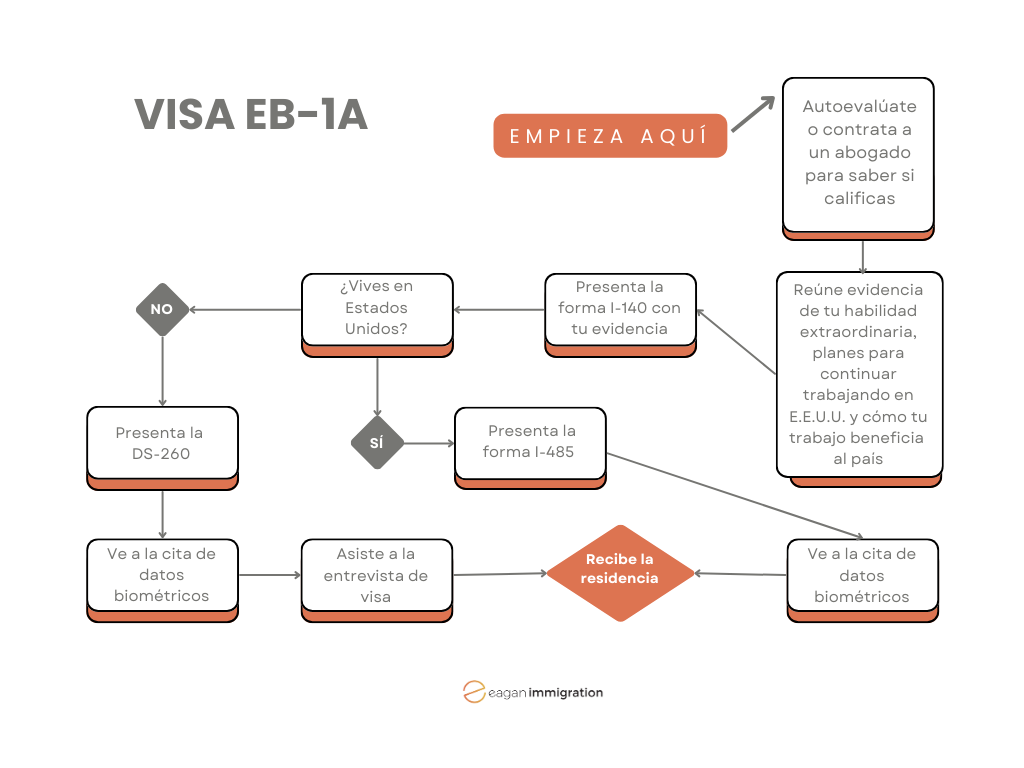
The first step in applying for the EB-1A is to file Form I-140 (Immigrant Petition for Alien Workers), which has a filing fee of $715. Along with this form, you will also submit evidence of extraordinary ability, evidence that you plan to continue working in your field once in the United States, and proof that your work will substantially benefit the United States. As of April 2024, the Nebraska Service Center takes 16.5 months to process Form I-140, and the Texas Service Center takes 19 months. Compared to family-based petitions, which often take between 51.5 and 56.5 months, these are fast processing times. It is important to note that processing times often change, so if you are interested in applying for the EB-1A, it is a good idea to file your application while processing times are short. However, if you wish to expedite the processing time, you can request priority processing. By filing Form I-907 (Request for Priority Processing), which costs $2,805, USCIS will process your case in just 15 days.
Once your I-140 is approved, the next steps will vary depending on whether you live in the U.S. or in your home country. If you are in the U.S., you will adjust your status by filing Form I-485 (Application to Register Permanent Residence or Adjust Status), which costs $1,440. You’ll also need to attend a biometrics appointment to provide photographs, signatures, and fingerprints, and then you’ll need to attend an immigrant medical exam. Once your I-485 is approved, you’ll officially be issued a green card, which will allow you to work and live legally in the United States.
If you live outside the U.S. when your I-140 is approved, USCIS will transfer your case to the State Department’s National Visa Center for preliminary processing. You will then need to file the DS-260 (Electronic Immigrant Visa Application), which costs $345, at the U.S. embassy or consulate in your country to begin the consular process. From there, you will attend a biometrics appointment, undergo an immigrant medical exam, and have a visa interview. Once your application is approved, you will receive a green card and become an official lawful permanent resident of the United States.
Benefits of the EB-1A Green Card
Apart from the most obvious benefit of the EB-1A, which is the granting of a green card, this green card pathway has several other advantages:
You do not have to depend on an employer to sponsor you to work in the United States because this is a self-petitioned green card. Finding the right employer to apply can be a stressful and time-consuming process, and the self-petitioning process eliminates it completely.
Because the EB-1A visa does not require an employer to sponsor you, you have more flexibility in your employment options in the United States. Of course, you will still need to work in your field, but you will not be tied to a specific job as other employment-based green cards require.
Once you are granted the EB-1A green card, you can apply for your spouse and children under 21 for E-14 or E-15 immigrant status so they can live, work, and study in the United States.
Should I work with a business immigration lawyer?
Although the EB-1A is a self-petitioned green card, it can also be stressful to tackle the filing process on your own. Working with an experienced business immigration lawyer, such as Eagan's senior business attorney, Hannah Whaley, can alleviate much of the stress you might face during the filing process. Attorney Whaley can determine if you meet the USCIS requirements for extraordinary ability, help you gather the required evidence, and present creative arguments to show that you will continue working in the U.S. and that your work will substantially benefit the country. Attorney Whaley can also keep you updated on the filing process and what the next steps are.
References
Policy Manual: Chapter 2 – Extraordinary Ability, USCIS, (April 10, 2024), Chapter 2 – Extraordinary Ability | USCIS, (last visited: April 11, 2024). Employment-Based Immigration: First Preference EB-1, USCIS, (March 1, 2022), Employment-Based Immigration: First Preference EB-1 | USCIS, (last visited: April 11, 2024).
Webinar: Self-Petitioning Options for U.S. Work Visas, Eagan Immigration, (March 28, 2024), Webinar: Self-Petitioning Options for U.S. Work Visas (youtube.com).
How can I prove that my work will “substantially benefit the United States”? Do I qualify for the EB-1A visa? Scott Legal, P.C., (April 8, 2020), Qualification and Understanding of the EB-1A Visa | Scott Legal, P.C. (legalservicesincorporated.com). Matter of Price, United States Department of Justice, (December 29, 1994), Matter of Price (justice.gov).
Victoria Chen, Esq., J.D., Case Study: EB1-A Appeal by a Master Chef Sustained and Petition Approved by AAO, Chen Immigration Blog, (December 30, 2011), Case Study: EB1-A Appeal by a Master Chef Sustained and Petition Approved by AAO. | Chen Immigration Blog (wegreened.com).
Victoria Chef, Esq. J.D., Case Study: AAO Sustained an EB-1A Petition Appeal on Behalf of an Inventor, Chen Immigration Blog, (Dec. 31, 2011), Case Study: AAO Sustained an EB-1A Petition Appeal on Behalf of an Inventor | Chen Immigration Blog (wegreened.com).
G-1055, Fee Schedule: I-140, Immigrant Petition for Alien Worker, USCIS, (last updated: April 1, 2024), Fee Schedule | USCIS, (last visited: April 11, 2024). Processing Times, USCIS, Processing Times (uscis.gov), (last visited: April 15, 2024).
G-1055, Fee Schedule: I-907 Request for Premium Processing Service, USCIS, (last updated: April 1, 2024), Fee Schedule | USCIS, (last visited: April 11, 2024).
G-1055, Fee Schedule: I-485, Application to Register Permanent Residence or Adjust Status, USCIS, (last updated: April 1, 2024), Fee Schedule | USCIS, (last visited: April 11, 2024). Visa Services Fees, U.S. Department of State – Bureau of Consular Affairs, Visa Services Fees (state.gov), (last visited: April 16, 2024).