By Natalie McQuilkin
Many international students with F-1 Academic Student Visa spend years in the United States earning their associate's, bachelor's, master's, or doctoral degrees. The F-1 visa allows you not only to continue your education in renowned colleges and universities in the US., but also gives you the opportunity to participate in curricular practical training o optional practical training so that you can hone your skills in your field of study, gain real-life work experience, and network with professionals.
For some students, figuring out what the future holds after their F-1 visa expires can be terrifying. They have acquired a great deal of educational and work experience in the U.S. and have established many connections while studying and working. Some students are unsure if they will find a job in their field of study when they return to their home country.
That raises the question: Is it possible to stay in the U.S. once you have obtained your degree through the F-1 visa?The answer? Yes, you are eligible for a self-petition (employment-based green card) or sponsorship.
Today, we will highlight how you can remain in the United States after completing your F-1 visa through various self-petition and sponsorship pathways. Sponsorships can be permanent or temporary in nature. These include the EB-1A, the EB-2 National Interest Waiver, the O-1, and the H-1B. We will also explain how you can prepare to apply for these visas and green cards while you are still a student so that you can make a smooth transition to life after graduation.
Self-petitioning vs. sponsorship pathways
Before diving into the options you can consider for your life after the F-1 visa, we need to break down the difference between sponsorship and self-petition pathways.
The sponsorship pathway requires you to have a petition from a U.S. employer for your green card or visa. This also requires the employer to provide you with a full-time job here in the U.S. This is attractive to many foreigners because it guarantees a job opportunity, and the petition process depends on your employer, rather than you. These factors can relieve much of the individual's stress. Meanwhile, for the self-petition visas or employment-based green cards, it is solely up to you to provide all forms, evidence, and payments to obtain the visa you are applying for. Although it may seem overwhelming to some, you can work with a business immigration attorney, such as Eagan Immigration, to ensure that you meet all the criteria and provide all the necessary evidence to strengthen your case. In addition, you don't have to find an employer to sponsor you, which can also alleviate a source of anxiety for some applicants.
Self-Petition Options: The EB-1A and EB-2 NIWThe EB-1A Visa: For Individuals with Extraordinary Ability in the Sciences, Arts, Education, Business, or AthleticsThe EB-1A visa allows you to become a lawful permanent resident in the U.S., which means you will obtain a green card once approved. This visa is designed for those who can “demonstrate extraordinary ability in the sciences, arts, education, business, or athletics through sustained national or international acclaim,” according to the U.S. Citizenship and Immigration Services (USCIS).So, what are the eligibility requirements for this visa?USCIS explains that, in order to “demonstrate that he or she has been acclaimed nationally or internationally and that his or her achievements have been recognized in his or her field of expertise,” he or she must be able to provide evidence of three based on the following criteria:
Receive nationally or internationally recognized awards or honors for excellence
Become a member of an association related to your field
Publish content about yourself in a professional journal or other major media outlet
Being asked to evaluate the work of others, whether as part of a panel or individually
Documentation on his contributions of great importance to the field
Authoring academic articles in professional journals or other media outlets
Have your work displayed in exhibitions or showcases
Hold leadership or key positions in a distinguished organization
Proof that you have had a higher salary than others in your position
Examples of his commercial success in the performing arts
This may seem like a daunting list, but keep in mind that you only need to provide three pieces of evidence from this list. In addition, according to Attorney Whaley’s webinar, there are many ways you can get a head start on meeting these criteria while you’re still a student:
Find and document your job and internship opportunities. Many students with F-1 visas have the option to work while studying through the Curricular Practical Training (CPT) or Optional Practical Training (OPT) programs. This allows you to work for any employer whether the training is related to what you're studying. Unlike CPT, OPT can take place before or after the end date of your program, and you can apply for 12 months of OPT at each educational level, such as bachelor's or master's degree levels. If you have been regularly employed through OPT and have earned a STEM degree, you can apply for the STEM OPT extension, which allows him to work for an additional two years in a STEM-related area, according to U.S. Immigration and Customs Enforcement (ICE). These training and internship options not only provide hands-on professional experience, but can also fulfill one of the aforementioned criteria, especially if you ask your supervisor about working on important projects, such as academic articles to be published in professional journals. Make sure that if you get an internship or job opportunity, you are documenting all the important projects you are working on so that you can demonstrate your skills and abilities when applying for this visa.
Work hard and apply for awards. The more awards you apply for, the higher the probability that you will receive an award. You can receive awards for your academic achievements or for co-authoring a published article. You can also contact your professors to ask if there are any available academic opportunities that could result in awards. Winning a single award checks off one of the criteria requirements.
Find opportunities to judge. One way to fulfill the “judging” requirement is to ask teachers if there are any evaluation opportunities in which you can participate. An example is volunteering at middle or high school science or history fairs. However, it is important that any judging that occurs is within your specific area of expertise and shows a clear demonstration of ability. Just as with internship opportunities, make sure to document where you judged, how the selection process took place, and for what field and level the evaluation opportunity was.
Join professional organizations. Joining or being invited to a professional organization that requires high performance from its members is a way to meet this requirement. It is important that these organizations are professional and require a certain level of skill, education, or merit to join.
As of February 2024, It takes the Nebraska Service Center 19 months to process the EB-1A and 22.5 months for the Texas Service Center to process it. However, you should know that you can pay for priority processing for your visa to be processed within 15 business days.
The EB-2 National Interest Waiver
While the EB-1A can be applied for at any educational level, the Waiver for EB-2 National Interest Waiver (NIW) It is designed for those with an advanced degree, those with a bachelor's degree plus five years of post-bachelor's experience, or those with exceptional ability. Most F-1 students will fall into the advanced degree or exceptional ability category, so that is what we will focus on in this section.
To meet the requirements of the first two categories, you must be able to provide documentation of your academic record and postgraduate experience, if necessary. If you are a student interested in meeting the exceptional ability category, which, according to USCIS, applies to those who have a “level of expertise significantly above that ordinarily encountered in the sciences, arts, or business,” must be able to provide evidence for three of the following criteria:
Your academic record shows that you have obtained a degree, diploma, or certificate related to your area of exceptional ability.
Letters from current or former employers documenting at least 10 years of full-time experience in your occupation. This can be a good option for students who are also entrepreneurs.
Evidence that you have earned a higher than average salary. According to Attorney Whaley's webinar, a couple of examples of this include being an artist who receives a commission for their work, or being an engineer who is paid to fix computers on the side. This shows that people pay you more than average for your skill or trade.
Membership in a professional association. To further establish your “extraordinary ability,” ensure this is a high-performance partnership that just anyone cannot join.
Recognition for their achievements and contributions in their field by their peers, government agencies, and professional and business organizations. Some examples of this include the recognition of your work while completing CPT or OPT, or if a document you co-authored was awarded after being published.
Whether you fall under the "advanced degree" category or the "exceptional ability" category, in order to file a self-petition, you must demonstrate that you meet the requirements for the National Interest Waiver, which shows that what you plan to do to work in the U.S. is of national importance and eliminates the need for you to have a job offer.
To qualify for the National Interest Waiver, you must prove the following three “prongs”, According to USCIS:
The “proposed effort” (or what you plan to do to work in the U.S.) has both substantial merit as a matter of national importance.
Is well-positioned to advance the proposed effort, and
After all, It would be beneficial for the US to waive the labor certification officer requirements and, therefore, labor certification.
You can prove each of these aspects by providing evidence, which is where an experienced business immigration lawyer is helpful. A business immigration lawyer can help you demonstrate that your proposed endeavor has substantial merit and national importance by presenting information about your field and how your position will help the U.S. In addition, your attorney can provide evidence regarding your achievements, degrees, and recommendation letters. Although you can file a petition yourself without outside help, having a trusted commercial lawyer by your side can simplify the process and improve your argument.Sponsorship Pathway Options: The O-1 and H-1B VisasThe O-1 Visa: For Individuals with Extraordinary Abilities or Achievements
The O-1 visa is a nonimmigrant visa that F-1 visa students can use. It is composed of two subcategories that can accommodate students:
The O-1A visa it is designed for those with extraordinary ability in the sciences, education, business, or athletics
The O-1B visa It is directed at those with extraordinary ability in the arts or extraordinary achievements in the film or television industry.
Unlike the previously mentioned pathways, this visa requires sponsorship from a US employer and a full-time job offer. Furthermore, it must meet three of the following criteria for each of the visas. The O-1A criteria They are the following:
Receipt of a nationally or internationally recognized prize or award. This may include doctoral thesis awards, doctoral scholarships, professional association awards, etc.
Membership in field-related associations that require members to have outstanding achievements.
Material published in trade/commercial publications or major media outlets.
Evidence of participation on a panel, or individually, in evaluating the work of others.
Evidence of your contributions to your field. This may include evidence that your work has been cited by other journals and testimonials about your work.
Evidence of authorship in academic articles, professional journals, or other media.
Documentation showing that the individual has been employed in a critical or essential capacity at distinguished companies or organizations.
Evidence of having acted or having performed in a leading or starring role in a distinguished production or event.
Evidence that you have achieved national or international recognition or achievements based on critical reviews or publications.
Evidence that it has a track record of significant commercial success or critical acclaim. This can be proven through box office ratings, its position in its field, or film or television ratings.
Evidence that organizations, critics, government agencies, or experts have recognized him for his achievements.
However, the fact that your industry does not top the lists does not mean you cannot qualify for the H-1B visa. Remember that this visa depends on your level of education and skill and that a U.S. employer is sponsoring you.
It is important to note that, due to its popularity, each year there are 65,000 H-1B visas available for those with a bachelor's degree, and 20,000 visas for those with a master's degree or higher. Many applicants are selected through a lottery process. We discuss these processes in more detail in
One of the main benefits of the H-1B visa is that it is a visa double entendre, This means you can live and work in the U.S., or you can apply for a green card while on the visa. If you plan to work solely on the H-1B visa, you can stay in the U.S. for up to six years. As of February 2024, the California Service Center takes 2.5 months to process the H-1B visa, the Vermont Service Center takes 2 months, and the Texas Service Center takes 1.5 months, According to USCIS.
How can I prepare for sponsorships as a student?
While self-petitions rely on your own experience and skills, sponsorship routes require you to find an employer willing to sponsor you, which can be a major undertaking. Here are some tips to consider from Eagan’s lead business immigration attorney, Hannah Whaley, if you’re an F-1 student interested in obtaining an O-1 or H-1B visa after earning your degree:
Build lasting relationships during your internships, CPT, and OPT. Don't just do your job and leave, make real connections in these jobs. Stay in touch with your managers and coworkers after you have finished your tasks. Ask if there are available opportunities or projects, even if they are unpaid. This is an excellent way to show an employer that you are dedicated to advancing in your field.
Red, red, red. Take advantage of all networking opportunities at your university. Get to know the people who supervise your internship, CPT, or OPT. Attend on-campus hiring events to interact face-to-face with companies. Browse LinkedIn to connect with companies and employers that have experience hiring foreigners.
Ask the right questions to US employers. Not every company have experience in hiring a foreign national, and not all companies know how to file a petition for a foreign national. It is important to ask a potential employer if they have hired immigrants in a similar position, or if they would be willing to hire a foreign national. You can also ask if there are temporary jobs that could lead to permanent positions within the company, and if those roles apply to foreign nationals. If your employer has questions, you can always Contact us Too!
How do I start?
Each of these visas has specific requirements, forms, and documentation, and it can be overwhelming to tackle it all on your own. An experienced immigration lawyer can guide you through all the necessary steps in the visa application process to ensure you have all the correct forms and documentation. Eagan Immigration's managing business attorney, Hannah Whaley, is pleased to help you apply for one of these visas so you can fulfill your dream of building a life for yourself in the United States after your F-1 visa has expired.
Call our office today at (202) 709-6439 or click in this link to contact Attorney Whaley.
ReferencesEmployment-Based Immigration: First Preference EB-1, U.S. Citizenship and Immigration Services, last updated March 1, 2022, Employment-Based Immigration: First Preference EB-1 | USCIS, (last visited: February 1, 2024).
Unlocking Opportunities: Visa Options for International Students Webinar, Senior Attorney Hannah Whaley, January 31, 2024, Unlocking Opportunities: Options Webinar student visa for international students | LinkedIn.
Employment-Based Immigration: Second Preference EB-2, U.S. Citizenship and Immigration Services, last updated: April 20, 2022, Employment-Based Immigration: Second Preference (EB-2) | USCIS, (last visited: February 1, 2024).
F-1 Curricular Practical Training (CPT), Department of Homeland Security, last updated: November 28, 2023, Curricular Practical Training F-1 (CPT) Study in the United States (dhs.gov), (last visited February 12, 2024).
F-1 Curricular Practical Training, Tufts University International Center, F-1 Curricular Practical Training – International Center (tufts.edu), (last visited February 12, 2024).Practical Training, U.S. Immigration and Customs Enforcement, last updated: April 12, 2023, Hands-on training | ICE, (last visited: February 12, 2024).
O-1 Visa: Individuals with Extraordinary Ability or Achievement, U.S. Citizenship and Immigration Services, last updated: March 3, 2023, O-1 Visa: Individuals with Extraordinary Ability or Achievement Extraordinary | USCIS, (last accessed February 5, 2024).
Chapter 4 – O-1 Beneficiaries: Appendix: Meeting O-1A Evidentiary Requirements, U.S. Citizenship and Immigration Services, last updated: January 24, 2024, Chapter 4 – O-1 Beneficiaries | USCIS, (last accessed February 5, 2024).
Chapter 4 – O-1 Beneficiaries: Appendix: Meeting O-1B Evidentiary Requirements, U.S. Citizenship and Immigration Services, last updated: January 24, 2024, Chapter 4 – O-1 Beneficiaries USCIS, (last accessed February 5, 2024).
Processing times, U.S. Citizenship and Immigration Services., Processing times (uscis.gov), (last accessed February 5, 2024).
H-1B specialty occupations, Department of Defense cooperative research and development project workers, and fashion models, U.S. Citizenship and Immigration Services, last updated: September 15, 2023, H-1B Specialty Occupations, Department of Defense Cooperative Research and Development Project Workers, and Fashion Models USCIS, (last accessed February 5, 2024).
H-1B Employer Data Hub, U.S. Citizenship and Immigration Services, last update: January 3, 2024, H-1B Employer Data Hub USCIS, (last accessed February 5, 2024).
The Dual Intent Immigration Concept, International Students and Scholars Services of the University Temple University, The Concept of Dual Intent Immigration | International Student and Scholar Services (last visited: February 5, 2024).
 English

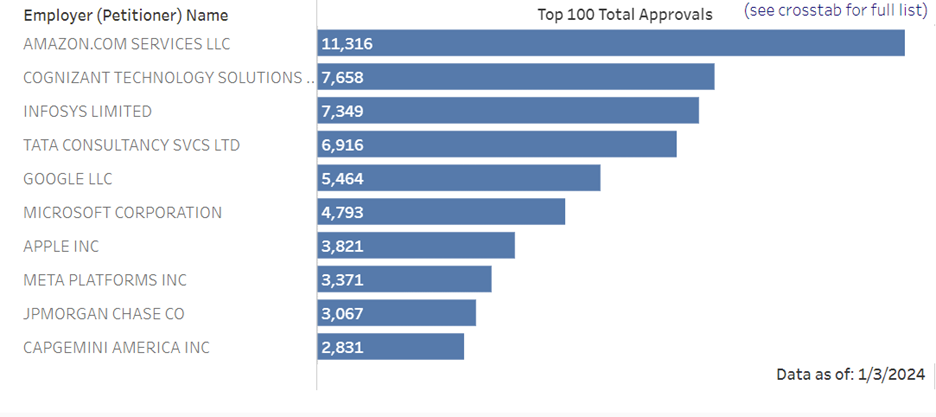 USCIS H-1B Employer Data Hub reveals that the companies that sponsored the largest number of H-1B visas as of January 2024 included Amazon, Cognizant Technology Solutions, Infosys Limited, Tata Consultancy Services Limited, Google, Microsoft, Apple, Meta, JPMorgan Chase & Co., and Capgemini America.
Starting in July 2023, the most common industries Those who applied for an H-1B visa on behalf of the beneficiaries included
USCIS H-1B Employer Data Hub reveals that the companies that sponsored the largest number of H-1B visas as of January 2024 included Amazon, Cognizant Technology Solutions, Infosys Limited, Tata Consultancy Services Limited, Google, Microsoft, Apple, Meta, JPMorgan Chase & Co., and Capgemini America.
Starting in July 2023, the most common industries Those who applied for an H-1B visa on behalf of the beneficiaries included