
 By Natalie McQuilkin
Since its creation in 1990, the EB-2 National Interest Waiver (NIW) self-petition pathway has gone through many changes. This pathway was originally designed for exceptional professionals in STEM fields, but over time, it has encapsulated a wider range of highly skilled professionals in fields like healthcare, education, and more. As we analyze the FY2024 (fiscal year) data for EB-2 NIW applications, we see that this self-petition pathway is continuing to evolve based on the applications that were approved and denied. In this post, we’ll highlight the EB-2 NIW’s FY2024 trends and what you can expect in FY2025 to increase your likelihood of approval.
Trends for EB-2 NIW approvals & denials in FY2024
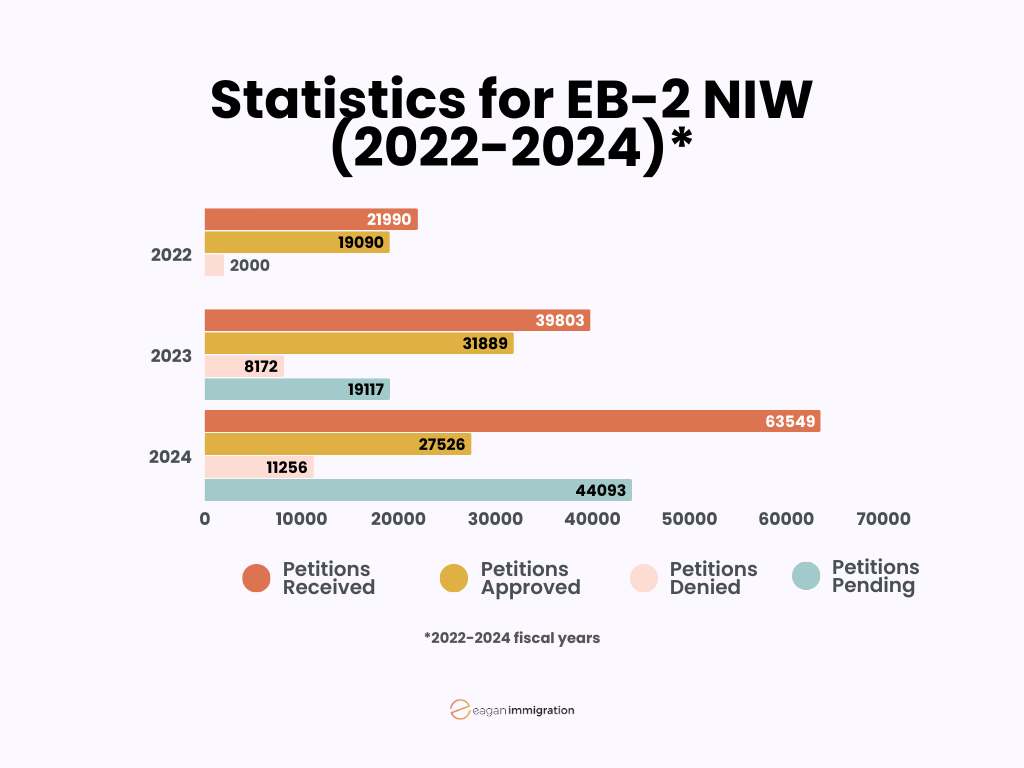
For years, EB-2 NIW self-petitions had an exceptionally high approval rate. In fact, 96% EB-2 NIW applications were approved in FY2022. In FY2023, however, the approval rate dropped to 80%. Unfortunately, FY2024 did not see any improvement – in fact, approvals were the lowest they’ve ever been. U.S. Citizenship and Immigration Services (USCIS) received a total of 63,549 EB-2 NIW petitions in FY2024. Of these, 27,526 petitions, or 43%, were approved, and 11,256 petitions, or 18%, were denied. There are still 44,093 petitions (69%) pending, creating a large backlog of EB-2 NIW petitions. It should be noted that the percentages are based on the number of petitions received, so they do not add up to 100% because there are pending cases from previous years. Still, this is a concerning drop in petition approvals.
By Natalie McQuilkin
Since its creation in 1990, the EB-2 National Interest Waiver (NIW) self-petition pathway has gone through many changes. This pathway was originally designed for exceptional professionals in STEM fields, but over time, it has encapsulated a wider range of highly skilled professionals in fields like healthcare, education, and more. As we analyze the FY2024 (fiscal year) data for EB-2 NIW applications, we see that this self-petition pathway is continuing to evolve based on the applications that were approved and denied. In this post, we’ll highlight the EB-2 NIW’s FY2024 trends and what you can expect in FY2025 to increase your likelihood of approval.
Trends for EB-2 NIW approvals & denials in FY2024
For years, EB-2 NIW self-petitions had an exceptionally high approval rate. In fact, 96% EB-2 NIW applications were approved in FY2022. In FY2023, however, the approval rate dropped to 80%. Unfortunately, FY2024 did not see any improvement – in fact, approvals were the lowest they’ve ever been. U.S. Citizenship and Immigration Services (USCIS) received a total of 63,549 EB-2 NIW petitions in FY2024. Of these, 27,526 petitions, or 43%, were approved, and 11,256 petitions, or 18%, were denied. There are still 44,093 petitions (69%) pending, creating a large backlog of EB-2 NIW petitions. It should be noted that the percentages are based on the number of petitions received, so they do not add up to 100% because there are pending cases from previous years. Still, this is a concerning drop in petition approvals.
 Why has there been a decrease in approvals?
It’s important to note that USCIS received roughly 41,500 more EB-2 NIW petitions in FY2024 than in FY2022—a 190% increase. As more people have submitted EB-2 NIW petitions, USCIS has become more rigorous in assessing these petitions by taking a closer look at applications to ensure that applicants either have an advanced degree plus five years of professional experience or that they possess exceptional ability in the arts, sciences, or business. USCIS is also more closely scrutinizing the three criteria for the National Interest Waiver, which include the following:
Why has there been a decrease in approvals?
It’s important to note that USCIS received roughly 41,500 more EB-2 NIW petitions in FY2024 than in FY2022—a 190% increase. As more people have submitted EB-2 NIW petitions, USCIS has become more rigorous in assessing these petitions by taking a closer look at applications to ensure that applicants either have an advanced degree plus five years of professional experience or that they possess exceptional ability in the arts, sciences, or business. USCIS is also more closely scrutinizing the three criteria for the National Interest Waiver, which include the following:
- Your work has substantial merit and is nationally important to the U.S.
- You have the knowledge and ability to work in your role in the U.S.
- It would be beneficial for the U.S. to waive typical requirements for other petitions, like job offer and labor certification, because it is evident your work will benefit the country