

By Natalie McQuilkin
Since its creation in 1990, the self-petition under the EB-2 category with a National Interest Waiver (NIW) has undergone numerous changes. Although it was initially designed for exceptional professionals in STEM fields, over time it has included more highly skilled professionals in areas such as healthcare, education, and more.
When analyzing the fiscal year 2024 (FY2024) data on EB-2 NIW petitions, we observe that this immigration pathway continues to evolve based on approved and denied applications. In this article, we highlight the FY2024 trends and what you can expect in FY2025 to increase your chances of approval.
EB-2 NIW approval and denial trends in FY2024
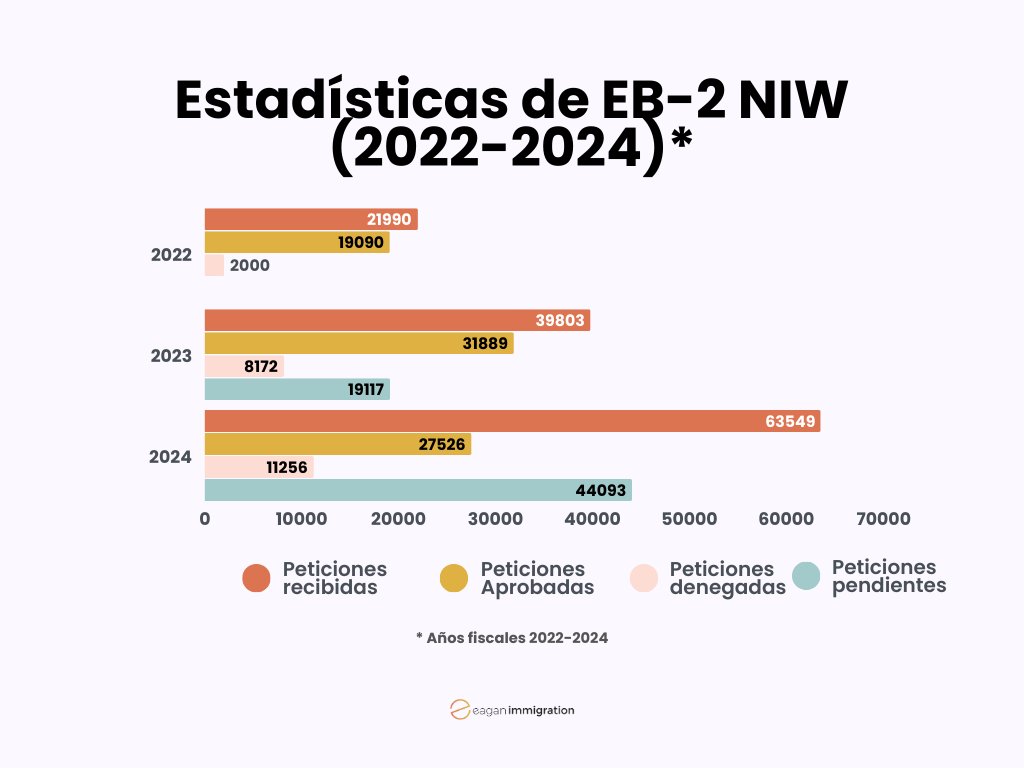
For years, self-petitions under the EB-2 NIW category had exceptionally high approval rates. In FY2022, 96% of the applications were approved. However, in FY2023, the approval rate dropped to 80%. Unfortunately, FY2024 showed an even greater decline, reaching the lowest level on record.
Why have approvals decreased?
USCIS received approximately 41,500 more applications in FY2024 than in FY2022, an increase of 190%. With this growth, the agency has become more rigorous in evaluating applications, ensuring that applicants meet the requirements:
✅ Have an advanced degree and five years of professional experience, or
✅ Possess exceptional skills in the arts, sciences, or business.
In addition, USCIS is examining in greater detail the three key criteria of National Interest Waiver:
1️⃣ Your work has substantial merit and is of national importance to the US.
2 You have the ability and knowledge to carry out your work in the US.
3 It is beneficial for the US to exempt you from typical requirements, such as a job offer and labor certification.
Immigration experts believe that this increased scrutiny seeks to ensure that the EB-2 NIW maintains its original requirements in the face of the increase in international applicants.
STEM vs. No-STEM: How does it affect approvals?
Another possible reason for the increase in denials is the shift in applications from STEM professionals.
In 2022, USCIS updated its guidelines to better evaluate STEM professionals. In 2023, these guidelines were expanded to include emerging industries such as renewable energies, artificial intelligence, and biotechnology.
Difference in denial rates in FY2023:
- STEM 2,120 denials (10%) out of 20,950 applications.
- No-STEM: 3,920 denials (33.2%) out of 11,810 applications.
Although applicants without a STEM background can still self-petition, it can be harder to demonstrate the national importance of their work without proper documentation and arguments. Therefore, now more than ever, it is essential to present solid evidence and well-structured arguments.
What can we expect in 2025?
The future of the EB-2 NIW continues to evolve. The January 15, 2025, USCIS announced that it will update its policy to evaluate each application in more detail. The agency will analyze how an applicant's exceptional abilities are related to their project in the US.
The positive: You will be able to strengthen your application using your experience and specific plans.
The challenging part: USCIS might evaluate your proposal and evidence with more skepticism.
Furthermore, with the President Trump in office, there may be further changes and even stricter criteria, which could affect both STEM cases and those in other industries.
How to increase your chances of approval?
While the increase in denials may seem discouraging, this does not mean you should give up on your dream of obtaining an EB-2 NIW. The key is to submit a detailed and strategic application.
Be specific in your proposed project and how does it benefit the US.
Contribute conclusive evidence of your merit and achievements.
Make sure to comply with the three criteria of the National Interest Waiver.