- The Latino vote is the second most influential among all ethnic groups in the United States, after the white vote. It is estimated that 11.6 million Latinos will vote in the midterm elections in November. 80% of the Latino population are eligible to vote in this election, and that percentage increases each year. This enormous electoral potential is not reflected in what we call the Hispanic agenda.
- There are almost 12 million Latinos – that have the right to vote – who are not registered to cast their ballot.
- In the 2020 election for the House of Representatives, 69% of Latinos supported the democratic candidate and 27% supported the republican candidate.
As the mid-term election approaches in the United States, which will conclude on Tuesday November 8, the power that every individual has to vote is very important. You will vote for the members of
the Senate and House of Representatives. There are 435 total elected representatives and they are chosen according to the population of each state, with the lowest being 1 in Alaska, and the highest being 53 in California.
Of the 100 senators (2 in each state), 35 will be up for election this year. 34 are running for reelection and 1 senator announced their retirement. Each senator’s term lasts for 6 years.Many times, state elections happen at the same time and voters can also choose civil servants in their own city, like judges and mayors. The election this year is also very important because residents in
36 of the 50 states will also vote for their governor, who is the most powerful figure in the legislation and politics of each state. This mid-term election holds a significant amount of weight in determining the political direction of the local districts and of the entire country.
Latinos make up a large part of the United States population and they will have a great influence on the results. There are about
62.1 million Latinos in the United States, and it is estimated that
11.61 of these will vote in the election of 2022.
The Latino Vote
For the first time, Hispanic Latinos—a group in which the majority of voters are of Mexican origin—will be the largest electoral minority behind the white vote, which continues to be the majority, and ahead of the African American vote. Between 2018 and 2022, the group of Latino voters has grown the most, with almost 5 million new voters, many of whom are children of Mexican immigrants, contrasting with the 700,000 African American voters or the 1 million Asian voters.
In the last few presidential elections, people have hoped that the Latino vote would be a decisive factor in the election, and finally, this group is awakening and revealing its strength. Unfortunately, the election hasn’t taken place yet, and although growth is important, it doesn’t carry the weight it should. This enormous electoral potential is not reflected in what we call the Hispanic agenda. The Democrats’ positions in these elections regarding the legalization of abortion, while important, are not the most relevant issue.
The midterm elections represent a better opportunity for Latinos because their impact is local. In effect, the concentration of Latinos in certain states, combined with the electoral system, diminishes the weight of the Latino vote in the presidential election. For example, in California, where the Hispanic presence is strong, in the presidential election, winning the vote by millions is equivalent to winning by a small margin, and the white vote would be more than enough, making the Latino vote less useful, though still necessary.
In local elections, this is not the case, and the Latino vote can determine positions on issues that are important for the House of Representatives, the Senate, or the governor. This does not necessarily mean that a Latino candidate wins the election—as there are not enough Latino candidates—but it does mean that the winning candidate pays attention to the concerns of the Hispanic community.
Among the Latino candidates for the House of Representatives, NALEO assigns the highest probability of winning to Democrats Robert Garcia of California, Maxwell Alejandro Frost of Florida, Delia Ramirez of Illinois, Robert Mendez Jr. of New Jersey, and Greg Casar of Texas, as well as Republican Anna Paulina Rubio of Florida. For the first time since this survey began, data is included on Latino registered voters in California, Florida, and Texas—states with some of the closest races in the country.
In Texas polls, Democrat Beto O’Rourke leads Republican Gregg Abbott in the governor’s race by a margin of 59 to 26%. Abbott is part of a group of Republican governors who, since April, have sent thousands of asylum seekers to Democratic states to protest Joe Biden’s immigration policies. More than 75% of Latino voters in that state, which shares a border with Mexico, support protecting DACA recipients—those who came to the United States as children (also known as “Dreamers”). They also support a law guaranteeing access to abortion.
Among Latino voters in Arizona, Democrat Mark Kelly leads Republican Blake Masters in Senate polls, and Democrat Katie Hobbs leads Republican Kari Lake in the gubernatorial race. In Arizona, 37% of Latino voters say they are in a worse economic situation than they were two years ago, compared to 29% nationally.
In Florida, Latino voter support for Republicans is higher than in any other state. Republican Ron DeSantis leads Charlie Crist in the gubernatorial race by a 43 to 37% margin, and Republican Marco Rubio leads Democrat Val Demings in the Senate race by a 44 to 38% margin.
In California, Democrat Alex Padilla holds a comfortable lead over Mark Meuser in the Senate race. “The politicians who take Latino issues seriously have been rewarded with strong electoral positions” in these elections, said Adrian Pantoja of BSP Research.
In California and Texas, with 8.3 million and 6.2 million voters, respectively, one in every three voters will be Hispanic, and in New Mexico, one in every two voters is Latino. Adrian Fontes in Arizona and Francisco “Cisco” Aguilar in Nevada are Latinos committed to strengthening our democratic institutions, protecting the voting rights of all citizens, and making the electoral process easier and more secure.
The number of Latinos in the U.S. House of Representatives could rise from 38 to 45 in the legislative elections on November 8, which would set a new record, as confirmed this Wednesday by NALEO.
The most recent survey by the National Association of Latino Elected and Appointed Officials (NALEO) and BSP Research confirms that the majority of Latino voters favor the Democratic Party over the Republican Party in the race for Congress by a margin of 58 to 32%. 14% have voted early, and 8% are still undecided.
Of the 38 seats currently held by Latino members of Congress in the House, 34 will be retained or filled by other Hispanics, and “We are monitoring the other 11 races where we believe a Latino will be elected to represent a district for the first time,” confirmed Arturo Vargas, director of NALEO, in a video press conference. If all 11 are elected, the total number of Latino representatives will rise to 45 for the first time and will account for more than 10 percent of all lawmakers.
Demographic Data of the Latino Vote
According to the 2020 Census data, there are approximately
62.1 million Latinos living in the United States. Over the past 10 years, the Latino population has increased by 16%, now accounting for 18% of the total population.
They represent the largest ethnic group in the country, after the whites. In the 2020 election, they were the largest minority group, replacing the African American community.
Of the Latino population, 80% are U.S. citizens and can vote. That means that
four out of every five Latinos was either born in the United States or one of its territories, or was born outside of the country and became a naturalized citizen of the United States.
This number is only growing. 800 thousand more become citizens every year. Also, an average of 1 million Latinos turn 18 each year and turn into potential voters. The relevance of the Latino vote is growing and is causing them to be a potential impact on the results of elections.
Origin, Location, Identity, Age and Education
Even though the majority of Latinos are U.S. Citizens,
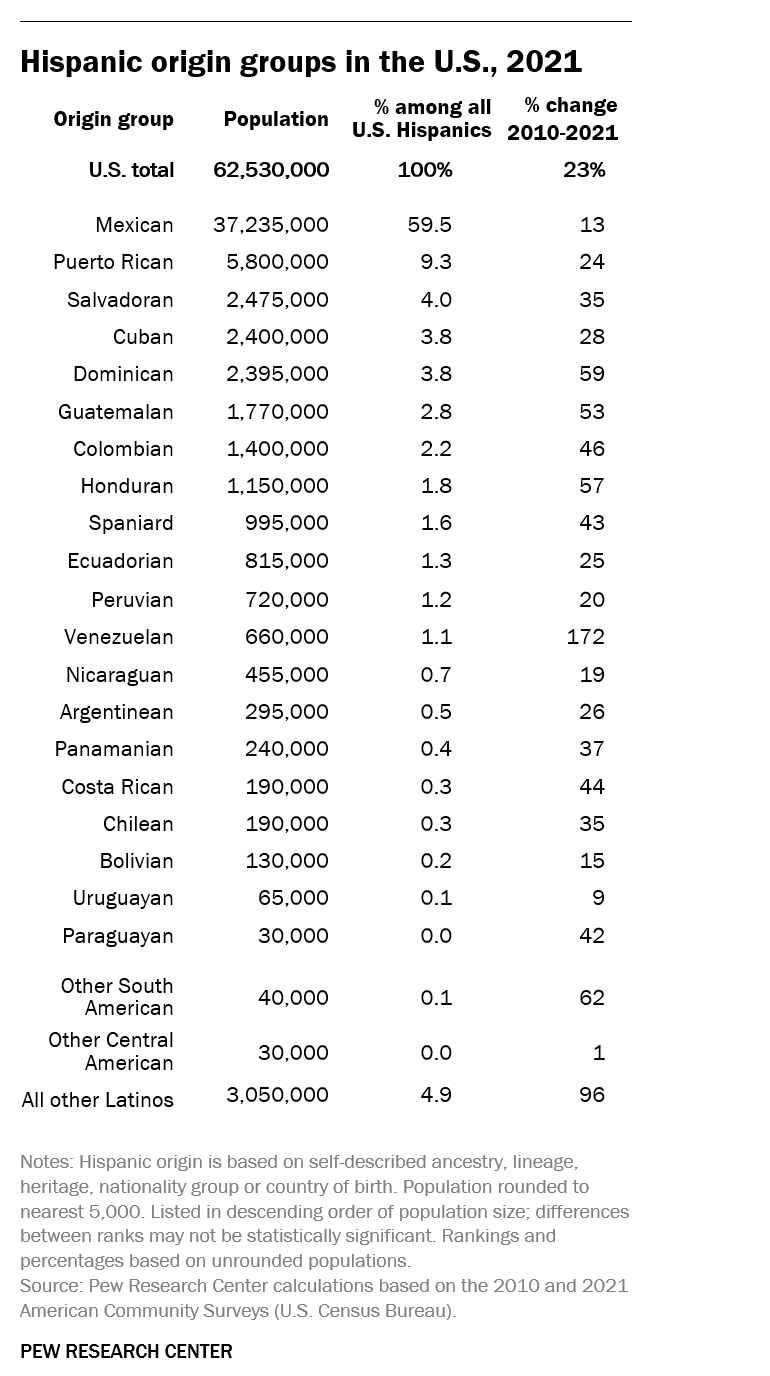
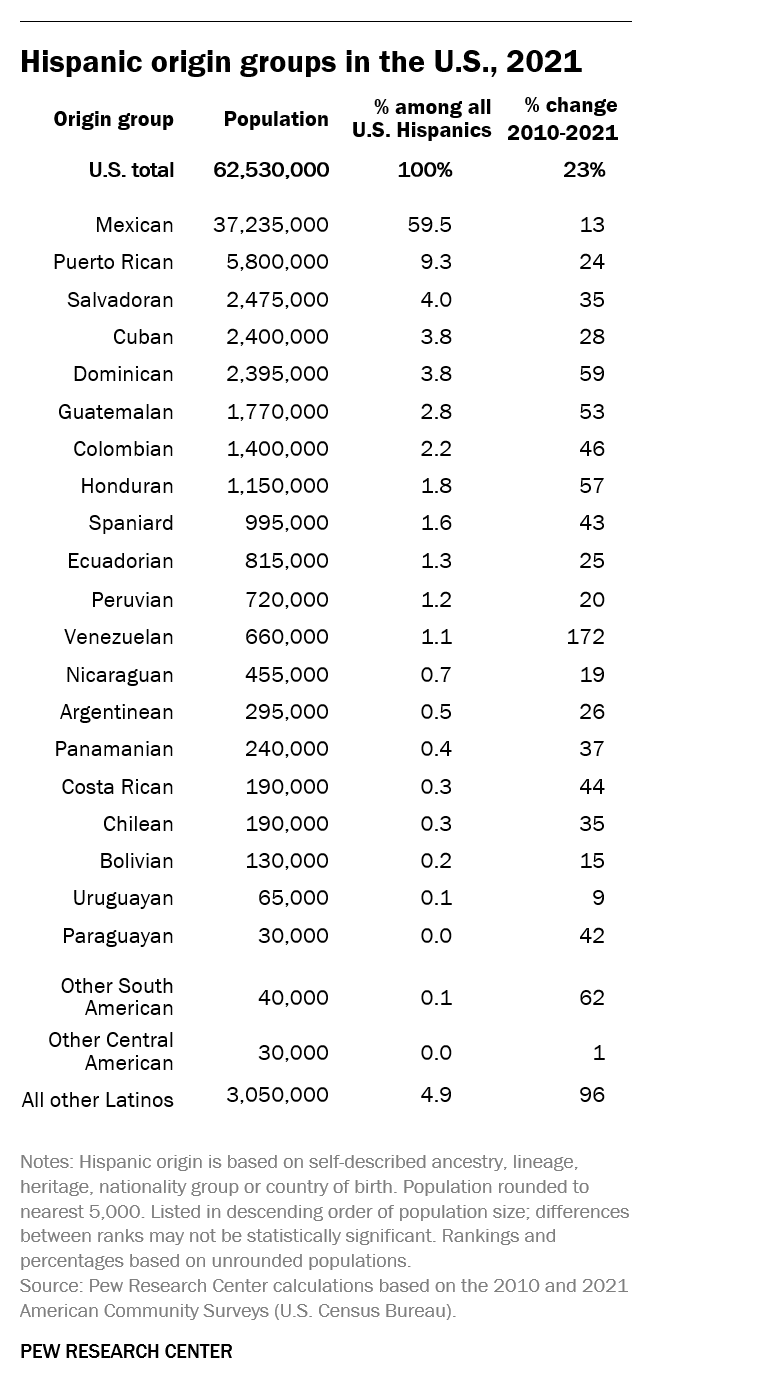
according to the Pew Research Center, 33% of them were not born in the United States. According to the Pew Research keys for Hispanic Heritage month this year, with numbers from 2021, the Latino vote is comprised of groups of diverse origin. Mexican’s make up the largest percentage of the Latin population, with some 37.2 million people, which makes up 62% of this group. In second place are Puerto Ricans (5.8 million, and 3.1 million living on the island). Six other countries have 1 million or more citizens each, Salvadoran, Cuban, Dominican, Guatemalan, Colombian, and Honduran. Spaniards represented about 1 million Latinos in the U.S. according the last measurements.
The states with the highest Hispanic population are: California, Texas, Florida, New York, Arizona and Illinois, in that order. Furthermore, California, Texas and Florida are the most populated states in the country, for which the results of their elections have a great impact on the entire country. Additionally, almost a quarter of the Latino population identifies as Afro-Latino. Therefore, the Latino vote include people with diverse backgrounds with their own identities and identifiers. From there, you can talk about the Latino communities in plural, not as one monolithic community. The average age of Latinos, 29 years old, is lower than the national average, which is 39 years old. Therefore, the Latino vote, in some ways, is also representative of young voters. Of the total Latino population, approximately 70% has an advanced level of knowledge of English. For reference, 25% of those over 25 years old have studied at least two years at a university, and
16% have a bachelor's degree or higher. This data is low in comparison with the total U.S. citizen population, where
90% have completed high school, and nearly 34% have at least a bachelor's degree.In summary, the Latino voters have a singular perspective, with their own challenges and desires that impact the way they look at things and their political opinions.
In past elections,
the data has shown that the Latino vote has a tendency to favor the Democratic Party. In the
presidential election in 2020 In the race between Donald Trump (Republican) and Joe Biden (Democrat), 70% voted for Biden and 27% for Trump. In the House of Representatives election,
69% supported a Democratic candidate, while
27% supported a Republican candidate.
12 Million Latinos Who Can Vote Are Not Registered And Cannot Do So
Even though we know that the Latino vote is one of the most relevant in U.S. elections, its influence still has not reached its potential.
Almost 12 million people in this group could vote, but are not registered, and therefore, cannot cast their vote this election. This is very important because they have the potential to change the results if everyone participated in elections, especially in swing states where it is not clear if the people will vote democrat or republican. In these states, the preferences change with each election depending on who runs in the election and who votes.
These states have the potential to change what political party will reach the majority in the Senate and the House of Representatives. In this context, every vote is important to determine the results in every state, and therefore, the political future of our nation.
In some swing states, like Texas and North Carolina, the young Latino vote is growing more rapidly than any other demographic group, and has the potential to change the results if every new voter registers and casts their ballot.

To register to vote in any election, there are many resources available. You can register online
here. Every state has its own registration regulations. If online registration is not possible, it can be done in person or by mail.
It doesn’t matter if you vote democrat or republican. What matters is that the Latino agenda is priority in regard to better jobs, access to education and health services, and why not, an immigration reform that has been promised so many times that would legalize our family and friends. What matters is what we value most in the United States: our right to vote. Let’s make our votes decide the elections and let’s hold our leaders accountable.
We have to start somewhere, and that won’t be the presidential election. We’ll get there, but now we have to support our local elections, and this November 8 is a good opportunity.
During these elections, we celebrate the halfway point of the current presidential term. All 435 candidates of the House of Representatives will be on the ballot and 1/3 of the Senate seats will be voted on. Governor races and local positions are also in play.
References
US elections: What is the weight of the Latino vote. (2022). Chequeado. https://chequeado.com/el-explicador/elecciones-en-estados-unidos-cual-es-el-peso-del-voto-latino/
Afp, A. (2022). Latinos could break record for representatives in US Congress after elections. www.elheraldo.hn. https://www.elheraldo.hn/mundo/latinos-podrian-batir-record-de-representantes-en-congreso-de-eeuu-tras-elecciones-joe-biden-HO10781134
Santibáñez, J. (2022). OPINION: Latinos and the midterm election opportunity – Los Angeles Times. Los Angeles Times en Español. https://www.latimes.com/espanol/eeuu/articulo/2022-11-01/opinion-los-latinos-y-la-oportunidad-de-las-elecciones-de-medio-termino
Undefined, U. (2022, October 31). The Latino vote will decide the future of our democracy. Univision. https://www.univision.com/noticias/opinion/monica-garcia-voto-latino-decidira-futuro-nuestra-democracia