



By Natalie McQuilkin
The H-1B visa is a temporary non-immigrant visa that allows foreign nationals to work in specialty occupations in the United States. A major draw for foreign nationals applying for the H-1B visa is that it is a dual intent visa, which means you can live and work in the U.S. temporarily, or you can apply for a green card while holding the visa. Because of this, the H-1B is an excellent option if you want to gain work experience in the U.S. or if you hope to one day adjust your status and become a permanent resident.
Upon receiving the H-1B visa, you are permitted to work in the U.S. for an initial period of three years. After that, your employer can apply for a one-year extension until you reach the six-year visa limit. Then, you must “change to another visa category, leave the U.S. for at least one year before reapplying for a new H-1B visa, or pursue a green card to continue your stay and employment in the U.S.,” explains a Docketwise Immigration Software article .
For those who wish to apply for U.S. permanent residence, the six-year duration of the H-1B visa may seem like enough time to apply for and receive a green card. However, if you are from a country with a large backlog of green card applications, such as India or China, it can take years for USCIS to process these applications. As of July 2024, USCIS is processing employment-based visa applications for Indian nationals from 2012, as you can see in the table below. This means it will be several years before they begin processing applications submitted in 2024.
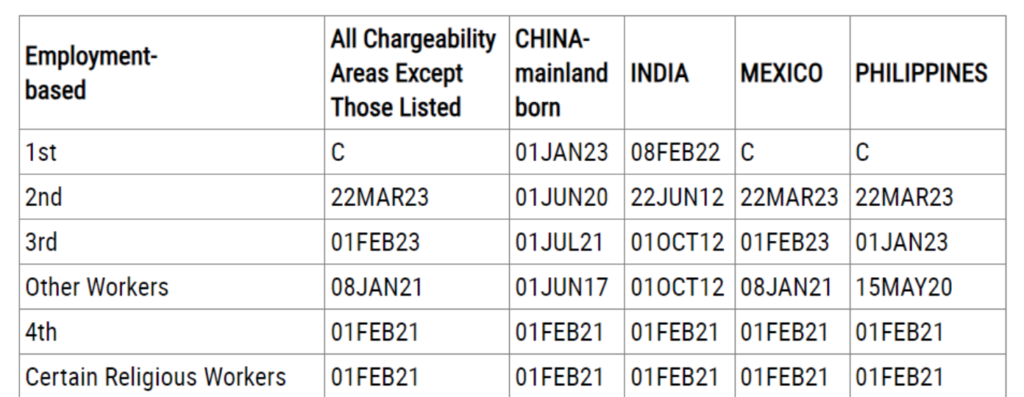
Aside from the delays, the process of finding an employer to sponsor you for an employment-based immigrant visa and your adjustment of status petition can take years.
So, what can you do if you are approaching your six-year maximum and are still waiting for your green card approval?
In this blog post, we are going to talk about the American Competitiveness in the Twenty-First Century Act of 2000, better known as AC21, that allows H-1B visa holders to work beyond the six-year maximum and change jobs while waiting to receive permanent residency.
What is AC21?
AC21 was created in October 2000 in the hope of encouraging more H-1B workers to come to the U.S., as there was a shortage of skilled workers in the country at the time. Essentially, AC21 allows you, as an H-1B worker, to obtain an extension on your visa so that you can continue working while waiting to receive your green card. This promotes job stability and minimizes gaps in your employment, while also ensuring that you maintain your legal status while in the United States.
Preliminary requirements for AC21
Before you can consider AC21, you must be waiting for your green card approval. This means you need a pending application to adjust your status with an employer who has agreed to sponsor you for one.
The first step in this process is to become the beneficiary of an immigrant work visa. The H-1B visa is a nonimmigrant visa, so it does not provide a path to permanent residency on its own. Instead, you will need to find an employer who will sponsor you for a first-, second-, or third-preference employment-based immigrant visa.
The first-preference employment-based visa, or EB-1, It is for outstanding professors and researchers or certain multinational managers or executives. In addition to those positions, it accommodates those with extraordinary abilities, such as those who have won a Pulitzer Prize or an Oscar, as we explain in this post. The EB-2, the second-preference employment-based visa, is designed to those with an advanced degree or exceptional ability. This may include engineers, medical professionals, business executives, artists, teachers, scientists, and more. Finally, EB-3, the employment-based third preference visa is for professionals, skilled workers, and other workers, or those with no work experience. Common jobs for professionals and skilled workers include healthcare professionals, engineers, teachers, and information technology specialists. Jobs for “other workers” include housekeepers, janitors, factory workers, construction workers, and more.
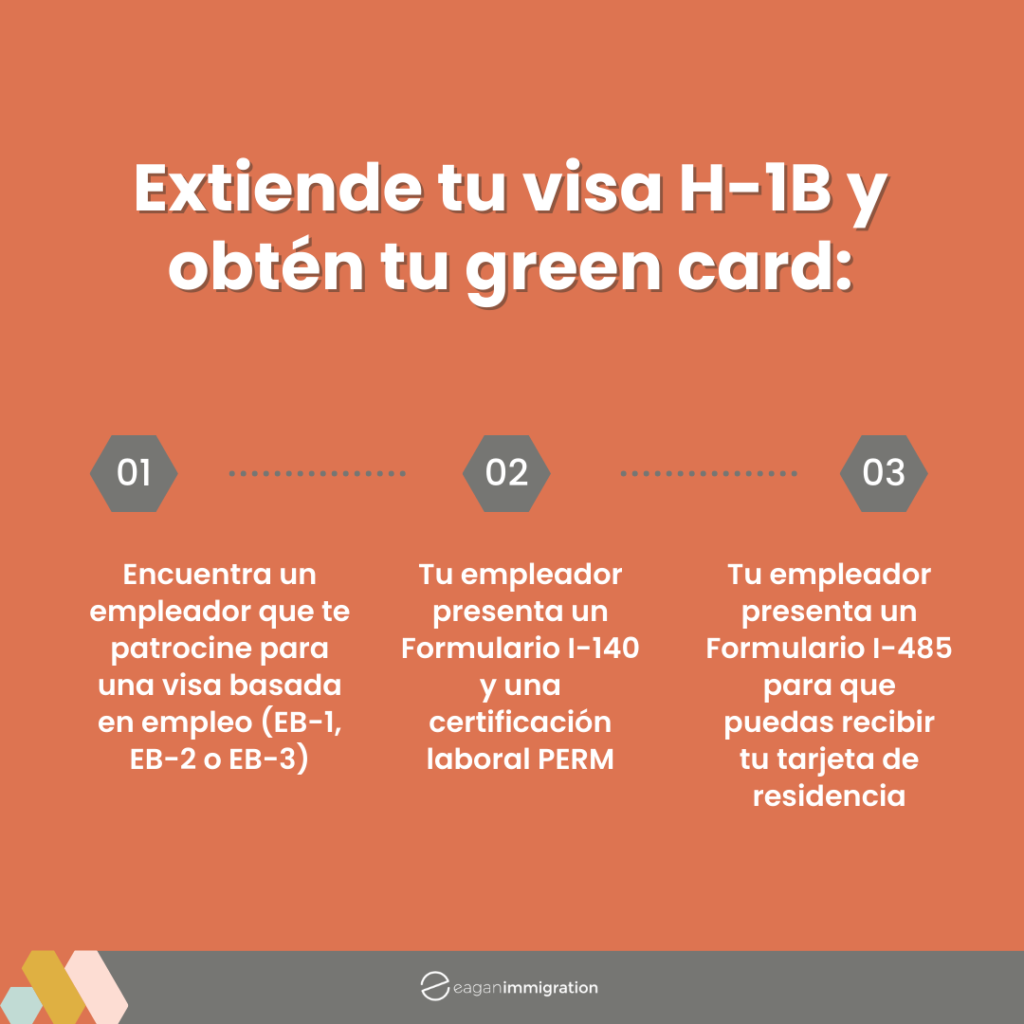
The first step in applying for these employment-based visas is to find an employer who is willing to hire you, and then have that employer file a Form I-140, or the Immigrant Petition for an Alien Worker. Your employer will also submit a PERM Employment Certification approved by the Department of Labor, which we discussed in this blog post, along with the Form I-485, Application to Register Permanent Residence or Adjust Status. Once these steps are complete, you will have already crossed out the first two USCIS requirements for AC21 eligibility:
- You are the beneficiary of an approved Form I-140 (Immigrant Petition for Alien Worker), or your Form I-140 petition is pending and awaiting approval
- Form I-140 petition is filed for employment-based EB-1, EB-2, or EB-3 visas.
 AC21 eligibility requirements for the extension
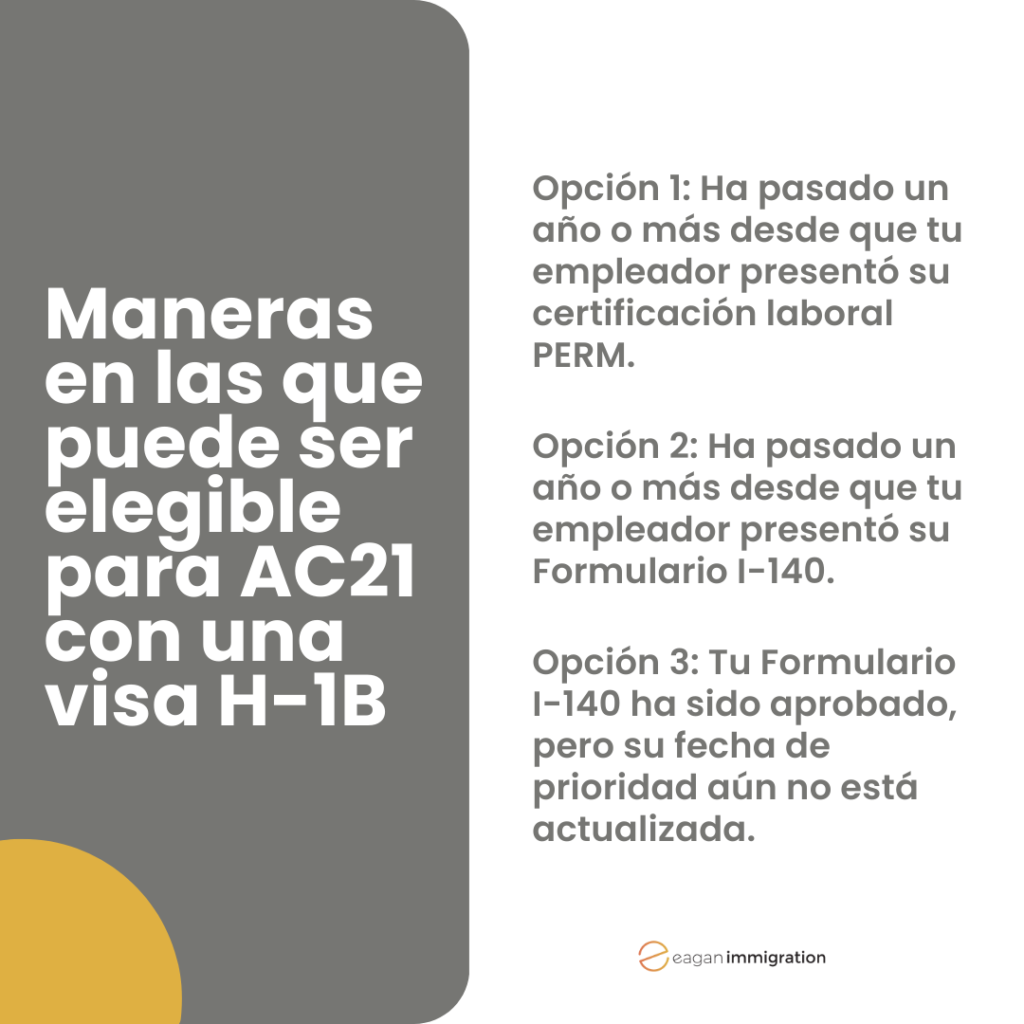
According to Temple University, you may be eligible to maintain your H-1B status beyond the six-year H-1B visa maximum if you fall into one of the following three categories:
- It has been a year or more since your employer filed a labor certification application for you to obtain employment-based immigrant status
- It has been a year or more since your employer filed Form I-140 for you as an employment-based immigrant
- Your Form I-140 has been approved, but your priority date to adjust status is not yet current
AC21 allows a one to three-year extension for their H-1B visa. To be eligible for a one-year extension, your PERM labor certification or Form I-140 must be filed at least one year before your H-1B visa expires. If your Form I-140 has been approved, but your priority date is not current due to backlogs, you may be eligible for a three-year extension. If none of these extensions provide enough time for you to remain in the United States while waiting to receive your green card, you may apply for another one-year extension as long as your labor certification or Form I-140 has been pending for more than a year.
Are you interested in extending your H-1B visa?
If you have an H-1B visa and hope to someday obtain permanent status in the United States, it is best to be proactive about your future now. This is especially true if you are nearing the end of your H-1B visa, or if you are from countries like China or India, which have major backlogs to overcome before the 2024 priority dates become current. Missing the deadline can have a major impact on your life. You may have to look for a different visa to remain in the United States, or you may need to return to your home country for a year before reapplying for the H-1B visa.
Using AC21 for an H-1B visa requires a lot of planning. Not only will you need to find an employer willing to sponsor you and file a petition for adjustment of status on your behalf, but you’ll also need to time everything correctly so that you’re eligible for an extension.
References
Visa Bulletin for July 2024, U.S. Department of State – Bureau of Consular Affairs, (June 5, 2024), Bulletin of Visas for July 2024 (state.gov), (last accessed: July 5, 2024).
Frank Gogol, Guide to AC21 and Green Cards in the U.S., Stilt, (Apr. 2024), COMPLETE Guide to AC21 and Green Cards in the USA [2024] (stilt.com).
Frank Gogol, Explanation of the H-1B Visa to Green Card Process, Stilts, (April 12, 2024), H-1B Visa to Green Card Process Explained [2024] (stilt.com)
Policy Manual: Chapter 5 – Labor Portability After Adjustment Filing and Other AC21 Provisions, USCIS, Chapter 5 – Employment Portability After Adjustment Filing and Other AC21 Provisions | USCIS, (last visited July 8, 2024).
Employment-Based Immigration: First Preference EB-1, USCIS, Employment-Based Immigration: First Preference EB-1 | USCIS, (last visited: July 5, 2024).
H-1B special status beyond six years, Temple University: International Student and Scholar Services, H-1B Special Status Beyond Six Years | Temple University International Student and Scholar Services (last visited: July 5, 2024).
James Pittman, Extending the H-1B visa status beyond six years with AC21, Docketwise Immigration Software, (June 24, 2024), Extending the H-1B Visa Status Beyond Six Years with AC21 – Docketwise Immigration Software.