



By Natalie McQuilkin
Deferred Action for Childhood Arrivals, more commonly known as DACA, provide many benefits for those who arrived in the US as children, such as protection against deportation, the ability to apply for a work permit and obtain a driver's license, and access to a social security number, education, and healthcare. Although these benefits allow DACA recipients to live in the US legally and without fear of deportation, DACA must be renewed every two years and does not provide a path to US citizenship or legal permanent resident (LPR) status.
The permanence of DACA in the United States government has also been at stake over the past decade, despite the fact that nearly 580,000 people receive DACA. In 2017, former President Donald Trump rescinded the DACA program, and it was not formally reinstated until January 2021 by President Joe Biden. However, that does not mean that DACA works as it did previously. Boundless explains that in October 2022, a federal judge “ruled that [DACA] could continue only on a temporary basis and that new applicants would still not be able to file an application.” As of May 2024, U.S. Citizenship and Immigration Services (USCIS) is “accepting initial DACA applications, but in accordance with the order [from the U.S. District Court for the Southern District of Texas], [USCIS] will not process initial DACA applications.”.
Temporary Protected Status, or TPS, has characteristics similar to DACA. TPS is designed for those facing an ongoing armed conflict, such as a civil war, an environmental disaster, or other extraordinary and temporary conditions, According to USCIS. Some countries designated for TPS beginning in June 2024 can be found here.
As with DACA, those who receive TPS can obtain a work permit and authorization to travel. You will need to re-register for TPS during each re-registration period to maintain your TPS status. However, There is no guarantee that the U.S. government will again designate a country as eligible for TPS, especially if the country's conditions change for the next re-registration period. Furthermore, TPS does not provide a direct pathway to LPR status or citizenship.
So, if neither DACA nor TPS provides a direct path to becoming an LPR or a U.S. citizen, what are your options?
Fortunately, having DACA or TPS does not prevent you from applying for permanent residency in the United States. There are many paths available that lead to green cards. In today's post, we'll discuss the EB-1A, EB-2, EB-2 National Interest Waiver, and EB-3 petitions. These are employment-based green card pathways that can put you on the path to receiving a green card.
The EB-1A Green Card
The employment-based first-preference visa, most commonly known as EB-1, is designed for three categories of people: those with extraordinary abilities, outstanding professors and researchers, and certain multinational managers or executives. In today's post, we will cover the EB-1A, the extraordinary ability green card, what else we excel at in a previous blog post.
One unique aspect of the EB-1A is that you do not need to be sponsored by an employer, which means that The EB-1A is a self-petition category. This is a great appeal for those who do not want to look for employers to hire and petition them, since it can be difficult to find employers who are familiar with those processes.
Now, let's take a look at what it takes to be eligible for the EB-1A.
The EB-1A category is intended for individuals in the sciences, the arts, education, business, or athletics who have received sustained national or international acclaim.. To be eligible for the EB-1A, you must demonstrate to USCIS that you have received a significant achievement, such as a an Olympic medal, an Oscar, or a Pulitzer Prize, which complies with three of the following ten criteria:
- Evidence of having received nationally or internationally recognized prizes or awards for excellence. These may include awards from national institutions or doctoral dissertation awards.
- Evidence of being part of an association in your field that requires members to have outstanding achievements
- Evidence of material published about you in major professional or trade publications or other major media outlets. Some examples of this include newspaper articles, textbooks, major online publications, or transcripts of professional or significant audio or video coverage.
- Evidence that you have been asked to evaluate the work of others, either individually or as part of a panel. Hannah Whaley, Eagan's lead business immigration attorney, explained in her Webinar on self-petitioning that an example of this is a model or pageant queen who is invited to judge a contest for younger participants. Another example is that of a scientist or professor who is invited to judge science fairs.
- Evidence of your original scientific, academic, artistic, athletic, or business-related contributions of major significance to the field. Support letters, patents, documentation indicating that your work has been cited, and publications about the importance of your work can be used to meet this category.
- Evidence of having authored scholarly articles in major professional or trade publications or other major media outlets
- Evidence that your work has been displayed in art exhibitions or displays
- Evidence of your performance in a leadership or critical role in distinguished organizations. USCIS explains that primary or critical roles include senior faculty or research positions; department chairs or heads; and founders, co-founders, or contributors to a startup or distinguished organization.
- Evidence of a high salary or significantly high remuneration relative to others in the field. You can provide tax returns, job offer letters, or documents comparing your salary to that of others in your field.
- Evidence of their commercial success in the performing arts. This includes the sales volume and box office revenue of a theatrical production, film, or television show.
In addition to meeting one of these three requirements, you must be able to provide USCIS with evidence showing that you who will continue his work in the United States So what? her work in her field will substantially benefit the United States. You can send proof of job offers, upcoming collaborations or projects, the success of your work in your field, and more.
Once you have gathered the required evidence, you will complete and submit the Form I-140 (Immigrant Petition for an Alien Worker) for the EB-1A petition with USCIS. As of June 2024, the Nebraska Service Center takes 14.5 months and The Texas Service Center takes 17 months to process these requests.
If you live in the U.S. under DACA or TPS, once your Form I-140 is approved, the next step is to file the Form I-485 (Application for Permanent Residency or Adjustment of Status), and attend a biometric appointment and a medical exam for immigrants. Once Form I-485 is approved, you will receive your green card.

The EB-2 Green Card
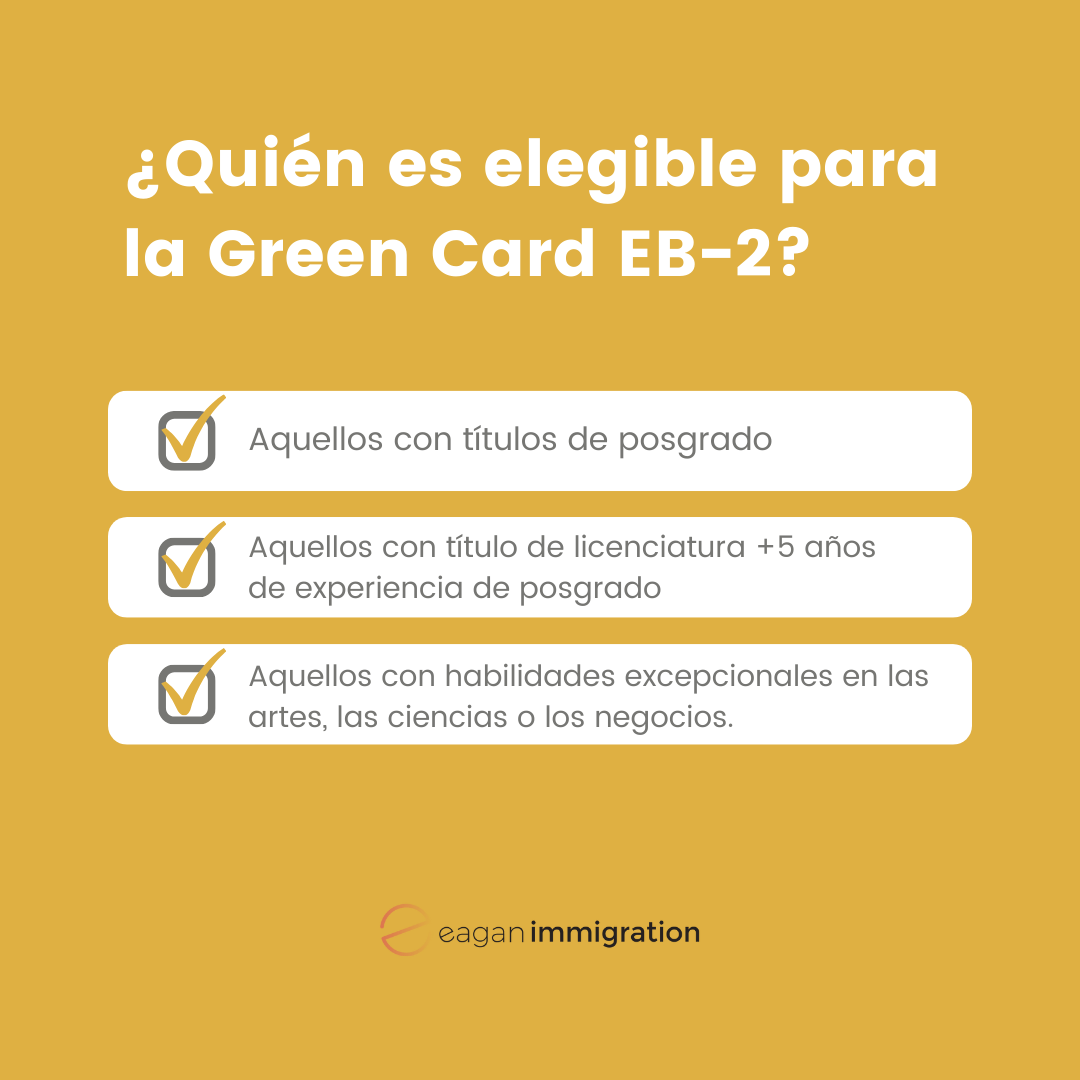
DACA and TPS recipients may also qualify for the second-preference (EB-2) employment-based green card. The EB-2 category covers three subcategories:
- Those who have a higher degree
- Those who have a Bachelor's degree plus five years of postgraduate experience
- Those with exceptional abilities in the sciences, the arts, or business.
Unlike the EB-1A, the EB-2 requires an employer to file a petition on your behalf. Although it may be daunting for some to find an employer who has previously petitioned for employees, working with an employer can provide a great deal of career stability. The employer also covers most of the filing fee, which is another advantage.
If you qualify under the advanced degree or bachelor's degree plus five years categories, you will only need to provide proof of your advanced degree or bachelor's degree and related work experience. If you fall under the exceptional ability category, you must provide three of the following criteria To USCIS:
- An academic record detailing your degree, diploma, or certification from a college, university, school, or other institution
- Recommendation letters from current or former employers documenting at least 10 years of experience
- A license or certification to practice your profession
- Membership in a professional association
- Recognition for achievements in their field by colleagues, government agencies, and/or professional or business organizations
- Evidence of having received a salary or other remuneration for services, demonstrating exceptional ability
Once you have gathered all the required documentation, your employer will need to obtain a permanent work certification, which we highlighted in a post on previous blog post. As of June 2024, the Nebraska Service Center takes 7.5 months in processing Form I-140 and the Texas Service Center 8.5 months. As we mentioned in the EB-1A section, once your Form I-140 is approved, you can file Form I-485 to adjust your status and receive a green card.
The EB-2 National Interest Waiver
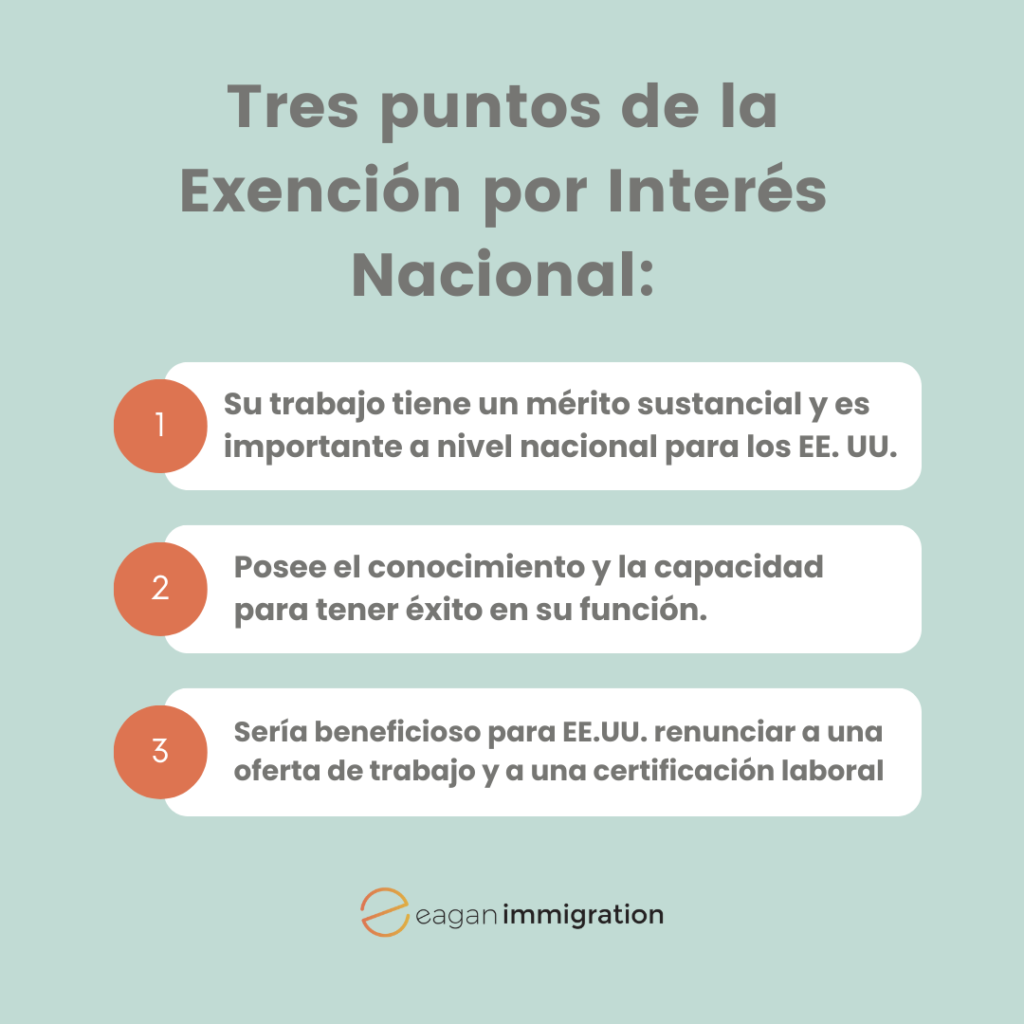
The EB-2 National Interest Waiver (NIW) It is very similar to the EB-2 green card in the sense that it is suited for those with an advanced degree, a bachelor's degree plus five years of experience, or exceptional ability. However, the main differences are that the EB-2 NIW is a self-petitioning path, and you must also apply for the Waiver for National Interest. This requires you to provide evidence of how your profession and/or exceptional ability is important and beneficial to the United States. The National Interest Waiver essentially “waives” any need for a permanent labor certification or a job offer, both of which are required for the general EB-2 green card. We excel in our blog post about the EB-2 NIW that creating a strong argument is the core of this green card petition. This is primarily because the NIW requires you to submit evidence to meet three requirements:
- Your work has substantial merit and is of national importance for the USA.
- He has knowledge and the ability to perform in their role in the US.
- It would be beneficial for the US to give up a job offer and labor certification because it is evident that their work will benefit the country
Because the EB-2 NIW does not require an employer to petition for you, you can bypass the labor certification process, which can save you time. As of June 2024, the Nebraska and Texas Service Centers are processing Form I-140 for the EB-2 NIW in 9.5 months.
The EB-3 Green Card
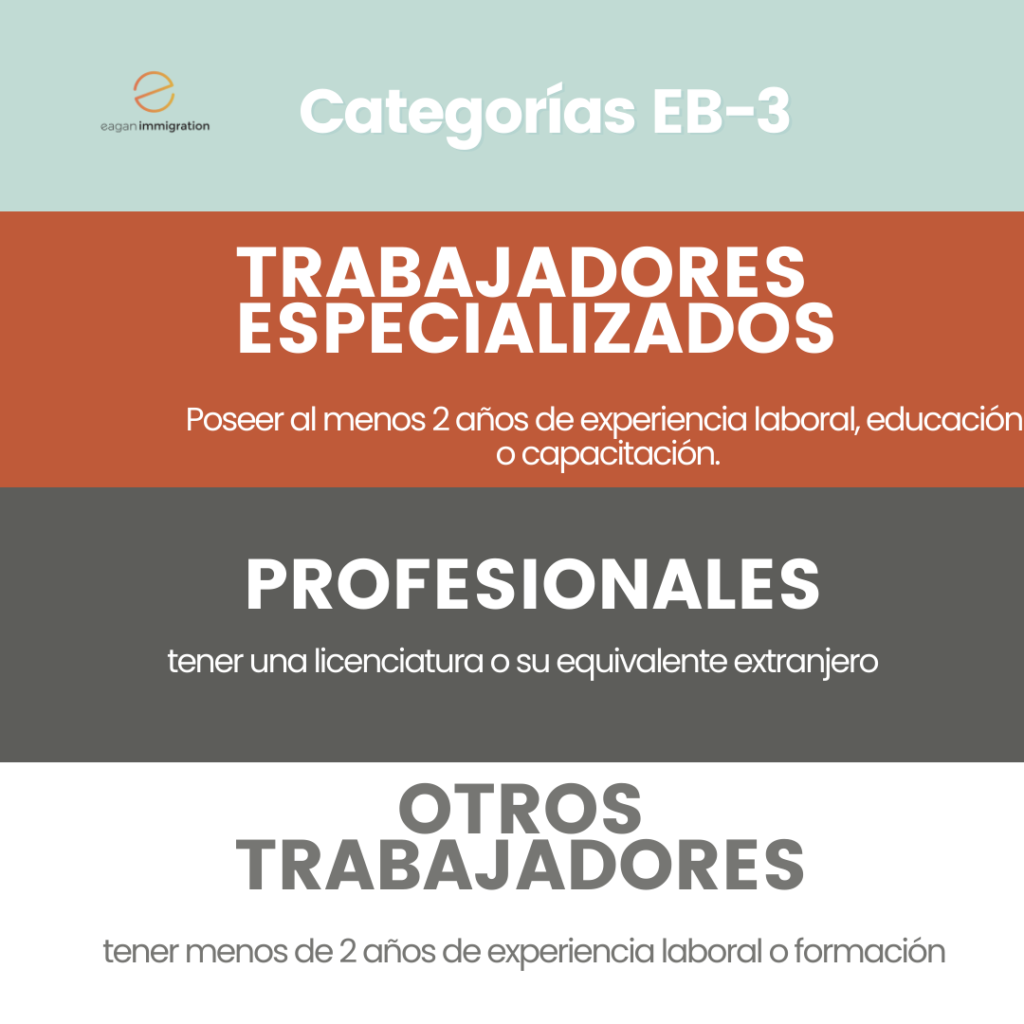
The last employment-based green card we are covering in today's post is the employment-based third preference (EB-3) green card. While the other employment-based green cards we have highlighted in this post require advanced degrees or extraordinary ability, this green card option is designed for skilled workers, professionals, and other workers.
As we mentioned earlier with the EB-2 green card, the EB-3 green card requires an employer to petition for you, which means this green card also requires you to receive a full-time job offer and your employer to obtain a labor certification.
According to USCIS, the skilled workers they must be able to provide evidence that they possess at least two years of work experience, education, or training that meets the job requirements specified in the labor certification.
The following EB-3 category is the one with professionals. To be eligible for this category, you must have a bachelor's degree or its foreign equivalent and meet other requirements specified in your employer's labor certification.
Finally, the EB-3 is extended to other workers, also known as “unskilled” workers. If you have less than two years of training or experience, but it can demonstrate that he can do unskilled work, can fit into this category.
As we mentioned with the EB-2 green card category, the EB-3 requires your employer to obtain a labor certification before hiring and petitioning for you. Once this is completed, your employer can file Form I-140. As of June 2024, the Nebraska Service Center is processing Form I-140 for EB-3 skilled workers and professionals in 7.5 months, while the Texas Service Center is processing them in 8 months. Meanwhile, Form I-140 for other EB-3 workers is being processed between 8 and 8.5 months at the Nebraska and Texas Service Centers.
Next steps
With so many employment-based green card pathways to choose from, it can be overwhelming to determine which one is best for you. At Eagan Immigration, our principal business attorney, lawyer Hannah Whaley, is here to help. Attorney Whaley can help you determine your eligibility, complete the required forms, present creative arguments, and guide you through the application process.
References
Deferred Action for Childhood Arrivals (DACA), explained, without limits, What is DACA? Everything You Need to Know – Boundless, (last accessed May 29, 2024).
Consideration of Deferred Action for Childhood Arrivals (DACA), USCIS, (April 8, 2024), Consideration of Deferred Action for Childhood Arrivals (DACA) | USCIS, (last visited: May 29, 2024).
Jasmine Aguilera, DACA has been completely reinstated. Here is what that means for the thousands of people who qualify for protection against deportation, TIME, (December 8, 2020), DACA has been completely reinstated. Here is why | EL TIEMPO.
Count of active DACA beneficiaries by current DACA expiration month, USCIS, (March 31, 2023), Active DACA Beneficiaries – March 31, 2023 (uscis.gov).
Temporary Protected Status, USCIS, (April 15, 2024), Temporary Protected Status | USCIS, (last visited: June 3, 2024).
Richard Link, J.D., What are my options after TPS expires? I don't, what are my options after TPS expires? | Nolo, (last visited June 3, 2024).
Employment-Based Immigration: First Preference EB-1, USCIS, (March 1, 2022), Employment-Based Immigration: First Preference EB-1 | USCIS, (last visited June 4, 2024).
Hannah Whaley, Webinar: Self-petition options for US work visas, Eagan Immigration, (March 28, 2024). Webinar: Self-Petitioning Options for US Work Visas – YouTube.
Processing Times, USCIS, Processing Times (uscis.gov), (last accessed June 4, 2024).
Employment-Based Immigration: Second Preference EB-2, USCIS, (April 20, 2022), Employment-Based Immigration: Second Preference EB-2 | USCIS, (last visited June 4, 2024).
Employment-Based Immigration: Third Preference EB-3, USCIS, (December 2, 2020), Employment-Based Immigration: Third Preference EB-3 | USCIS, (last visited June 4, 2024).